In the domains of embedded systems and industrial computing, ARM architecture processors have emerged as a mainstream choice due to their exceptional energy efficiency, flexible design, and extensive ecosystem support. However, ARM processors vary widely in clock speeds, ranging from hundreds of megahertz to several gigahertz. These differences significantly impact performance, power consumption, cost, and system complexity. This article examines the positioning and advantages of ARM processors across various applications, categorized by frequency bands.
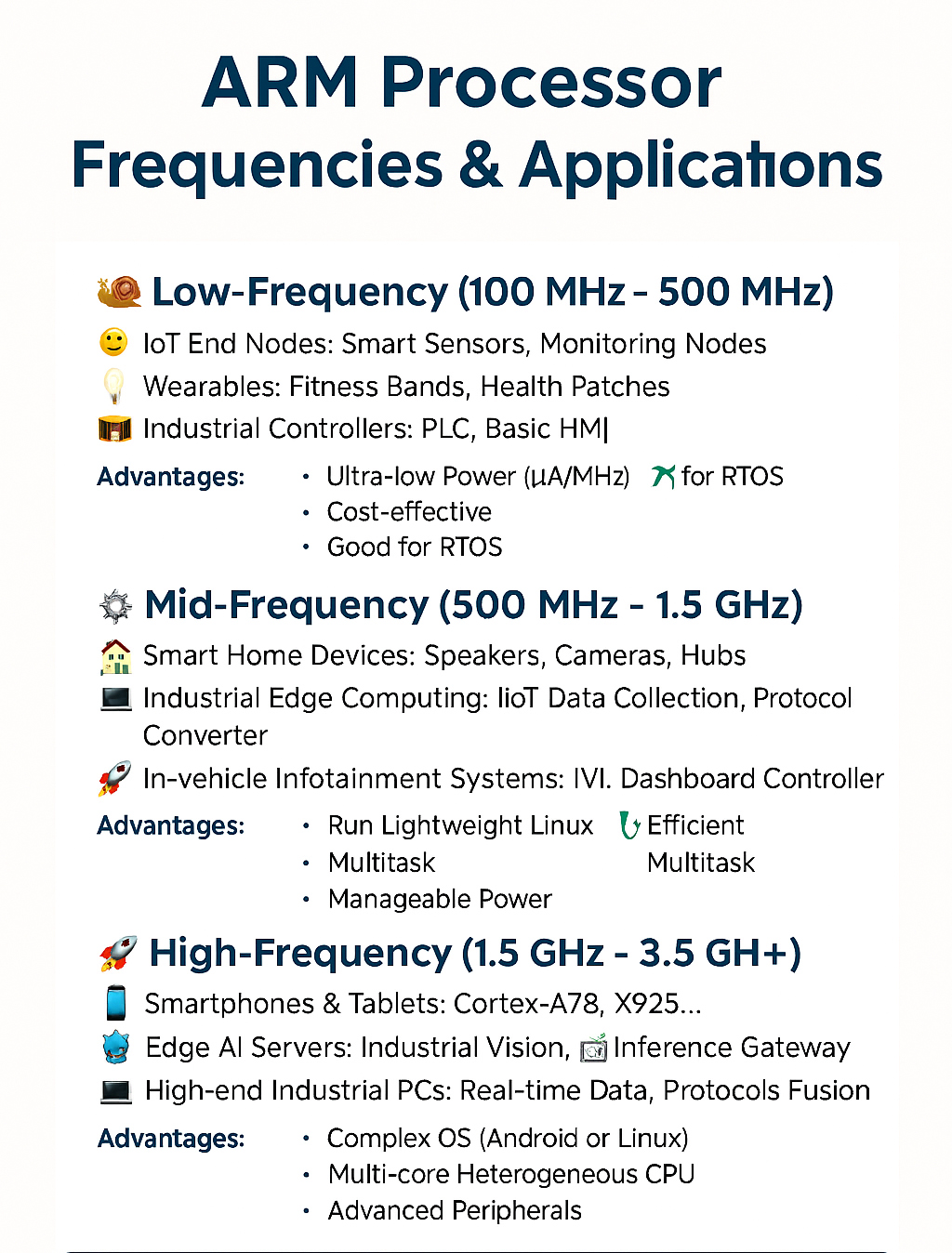
Low-Frequency Band (100 MHz – 500 MHz): Ultra-Low Power and Real-Time Performance
Application Characteristics
- Low performance demands, but high sensitivity to power consumption, cost, and size.
- Ideal for battery-powered devices requiring extended operation.
- Typically runs on Real-Time Operating Systems (RTOS) or bare-metal firmware.
Typical Applications
- Industrial Sensor Nodes: Such as Modbus RTU data collectors and LoRa terminals.
- Wearable Devices: Including health monitoring patches and fitness trackers.
- Smart Meters: Like water, gas, and electricity meters, or portable detectors.
- Remote I/O Modules: For GPIO expansion and analog signal acquisition.
Recommended Cores
- Cortex-M0/M3/M4/M33
- Cortex-R5 (for real-time control tasks)
Mid-Frequency Band (500 MHz – 1.5 GHz): Balancing Performance and Power Efficiency
Application Characteristics
- Requires moderate graphics processing, network communication, and multitasking capabilities.
- Supports Linux or lightweight embedded OS.
- Features rich peripheral interfaces (e.g., CAN, Ethernet, USB).
Typical Applications
- Industrial Edge Gateways: For protocol conversion, data preprocessing, and MQTT publishing.
- Smart Home Controllers: Such as Zigbee gateways and voice assistant hubs.
- In-Vehicle Infotainment: Including dashboard displays and central control units.
- Embedded HMIs: Like 7-inch touchscreen controllers.
Recommended Cores
- Cortex-A7/A9/A35/A53 (single- or dual-core configurations)
- Cortex-M7 (for high-performance MCUs)
Recommended Models
High-Frequency Band (1.5 GHz – 3.5 GHz+): Edge Intelligence and Complex Computing
Application Characteristics
- Multi-core heterogeneous architectures supporting AI inference and high-definition video processing.
- Runs full Linux/Android systems with containerization support.
- Suited for high-load scenarios like edge computing, industrial AI, and image recognition.
Typical Applications
- Industrial AI Edge Boxes: For defect detection, object recognition, and behavioral analysis.
- Smart Gateways/Edge Servers: Such as OPC UA aggregators with Docker deployments.
- High-End Industrial Tablets/IPCs: Including MES terminals and SCADA front-ends.
- Robot Controllers: For AMR main control and collaborative robot mid-controls.
Recommended Cores
- Cortex-A72/A76/A78/X1/X4
- Paired with co-processors like NPU, GPU, and ISP
Recommended Models
Selection Recommendations and Future Trends
The following table summarizes frequency recommendations based on application needs:
| Application Demand |
Recommended Frequency Range |
Typical Cores |
System Support |
| Ultra-Low Power Control |
100–300 MHz |
Cortex-M0/M3 |
Bare-Metal/RTOS |
| Real-Time Control + Communication |
300–800 MHz |
Cortex-M7/R5 |
RTOS/Linux |
| Multitasking + GUI |
800 MHz–1.5 GHz |
Cortex-A7/A53 |
Linux/Android |
| AI Inference + Edge Computing |
1.5–3.5 GHz+ |
Cortex-A72 + NPU |
Linux/Docker |
Looking ahead, as edge intelligence evolves, mid- to high-frequency ARM SoCs will increasingly integrate AI accelerators, ISPs, CAN-FD, and TSN for industrial features. Meanwhile, low-frequency MCUs will advance toward even lower power consumption and enhanced security (e.g., TrustZone and PSA certification). This progression ensures ARM processors remain versatile across the spectrum of embedded and industrial applications.


