Dry Contact Input and Wet Contact Input are two common signal input methods, primarily used in industrial control, automation systems, and electronic devices. Their main difference lies in whether the signal source includes a power supply (voltage or current). Below is a detailed explanation and comparison of the two:
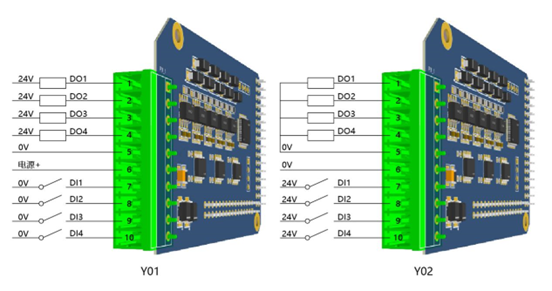
Dry Contact Input
-
Definition:
-
Dry contact input refers to a signal source that is not powered and only provides a switching contact (e.g., relay contacts, push-button switches, etc.).
-
The dry contact itself does not provide voltage or current; it is merely a mechanical contact.
-
Working Principle:
-
Dry contact input is typically used to detect switch states (e.g., open or closed).
-
An external circuit is required to provide power, and the input signal changes based on the contact's state.
-
Features:
-
Passive Signal: The dry contact itself is unpowered and requires an external power source.
-
Strong Anti-Interference: Since the signal source is unpowered, it is less susceptible to external interference.
-
Simple and Reliable: Suitable for detecting switch signals.
-
Applications:
-
Push-button switches, relay contacts, door sensors, etc.
-
Example: Detecting whether a door is closed or a button is pressed.
Wet Contact Input
-
Definition:
-
Wet contact input refers to a signal source that is powered and provides a voltage or current signal (e.g., sensor outputs, PLC outputs, etc.).
-
The wet contact itself is an active signal source.
-
Working Principle:
-
Wet contact input directly provides a voltage or current signal, which the input device reads directly.
-
No external power supply is needed, as the signal source itself is powered.
-
Features:
-
Active Signal: The wet contact itself is powered and directly provides the signal.
-
Diverse Signal Types: Can be analog signals (e.g., 4-20mA, 0-10V) or digital signals (e.g., high/low level).
-
Weaker Anti-Interference: Since the signal source is powered, it may be more susceptible to electromagnetic interference.
-
Applications:
-
Sensor outputs (e.g., temperature sensors, pressure sensors).
-
PLC output signals.
-
Example: Reading a 4-20mA signal from a temperature sensor.
Differences Between Dry Contact Input and Wet Contact Input
| Feature |
Dry Contact Input |
Wet Contact Input |
| Is the Signal Source Powered? |
Passive signal (unpowered) |
Active signal (powered) |
| Signal Type |
Switch signal (on/off) |
Analog or digital signal |
| External Power Required? |
Yes |
No |
| Anti-Interference Ability |
Strong |
Relatively weak |
| Typical Applications |
Push-button switches, relay contacts |
Sensor outputs, PLC outputs |
Examples
-
Dry Contact Input:
-
Scenario: Detecting whether a door is closed.
-
Implementation: A door sensor's contact is connected to a dry contact input. When the door is closed, the contact closes, and the external circuit detects the signal.
-
Wet Contact Input:
-
Scenario: Reading data from a temperature sensor.
-
Implementation: The temperature sensor outputs a 4-20mA signal, which is directly connected to a wet contact input. The input device reads the current value.
Summary
-
Dry Contact Input is suitable for detecting passive switch signals, requires an external power source, and has strong anti-interference capabilities.
-
Wet Contact Input is suitable for reading active signals, where the signal source itself is powered, and supports analog or digital signals.
-
The choice between dry contact and wet contact input depends on the specific application scenario and signal type.


