——Industrial and AI Edge Computing Practices with Rockchip RK3588 as an Example
With the rapid development of industrial automation, AI edge computing, and intelligent manufacturing, traditional single-performance-oriented processor architectures struggle to meet the comprehensive demands of high performance, low power consumption, strong real-time capabilities, and high reliability. In this context, the heterogeneous multi-core architecture of ARM core boards is emerging as the mainstream choice for industrial controllers, edge computing gateways, and embedded AI devices.
What is ARM Heterogeneous Multi-Core Architecture?
ARM heterogeneous multi-core refers to integrating multiple types of processing units within the same SoC, complementing each other in performance, power consumption, and functionality. Common combinations include:
- High-performance cores + high-efficiency cores (big.LITTLE)
- Application processors + real-time control cores
- CPU + dedicated accelerators like NPU/GPU/DSP
The core principle is to assign different tasks to the most suitable computing units, rather than overloading a single type of CPU.
Core Advantages of Heterogeneous Multi-Core for ARM Core Boards
- Optimal Balance of Performance and Power Consumption Industrial and edge devices often require 7×24-hour operation:
- High-load tasks (AI inference, image processing) → high-performance cores
- Background tasks (communication, logging, monitoring) → high-efficiency cores
- Idle states → core sleep or low-frequency operation Results: Full peak performance release, significantly reduced average power consumption, lower heat generation, and higher reliability.
- Natural Isolation of Real-Time Control and Complex Applications In traditional single Linux systems, real-time control is easily affected by scheduling and load fluctuations. Heterogeneous multi-core solves this through core division:
- Application cores (Cortex-A): Linux, containers, web services, AI frameworks
- Real-time cores (Cortex-M or independent small cores): Real-time IO, industrial buses, deterministic control logic Ideal for energy storage EMS/BMS, industrial automation, building HVAC control, and data center infrastructure management (DCIM).
- Significant Improvement in Multi-Task Parallel Processing Simultaneously handles diverse tasks:
- Sensor data acquisition
- Industrial protocol parsing
- AI inference and analysis
- Local HMI
- Cloud communication and management Reasonable task allocation leads to lower overall latency, faster response, and more stable operation.
- Higher System Stability and Industrial Reliability "Zero downtime" is a rigid requirement in industrial systems. Heterogeneous multi-core enables:
- Physical isolation of control and application tasks
- Core-level watchdog and fault recovery
- Single-point failures do not affect the overall system Even if Linux applications crash, underlying control logic remains stable.
- Better Support for AI Edge Computing Deployment AI inference requires collaboration beyond raw compute power:
- CPU: Data preprocessing, logic judgment, scheduling
- NPU: Efficient neural network inference
- GPU: Parallel computing, graphics, and visualization Heterogeneous multi-core ensures AI applications on the edge "run efficiently, sustainably, and reliably."
Why RK3588 is a Typical Representative of Heterogeneous Multi-Core
Among numerous ARM SoCs, Rockchip RK3588 stands out as a highly representative platform in industrial and AI edge fields, achieving excellent balance in performance, power, and integration.
In-Depth Analysis of Heterogeneous Multi-Core with RK3588
-
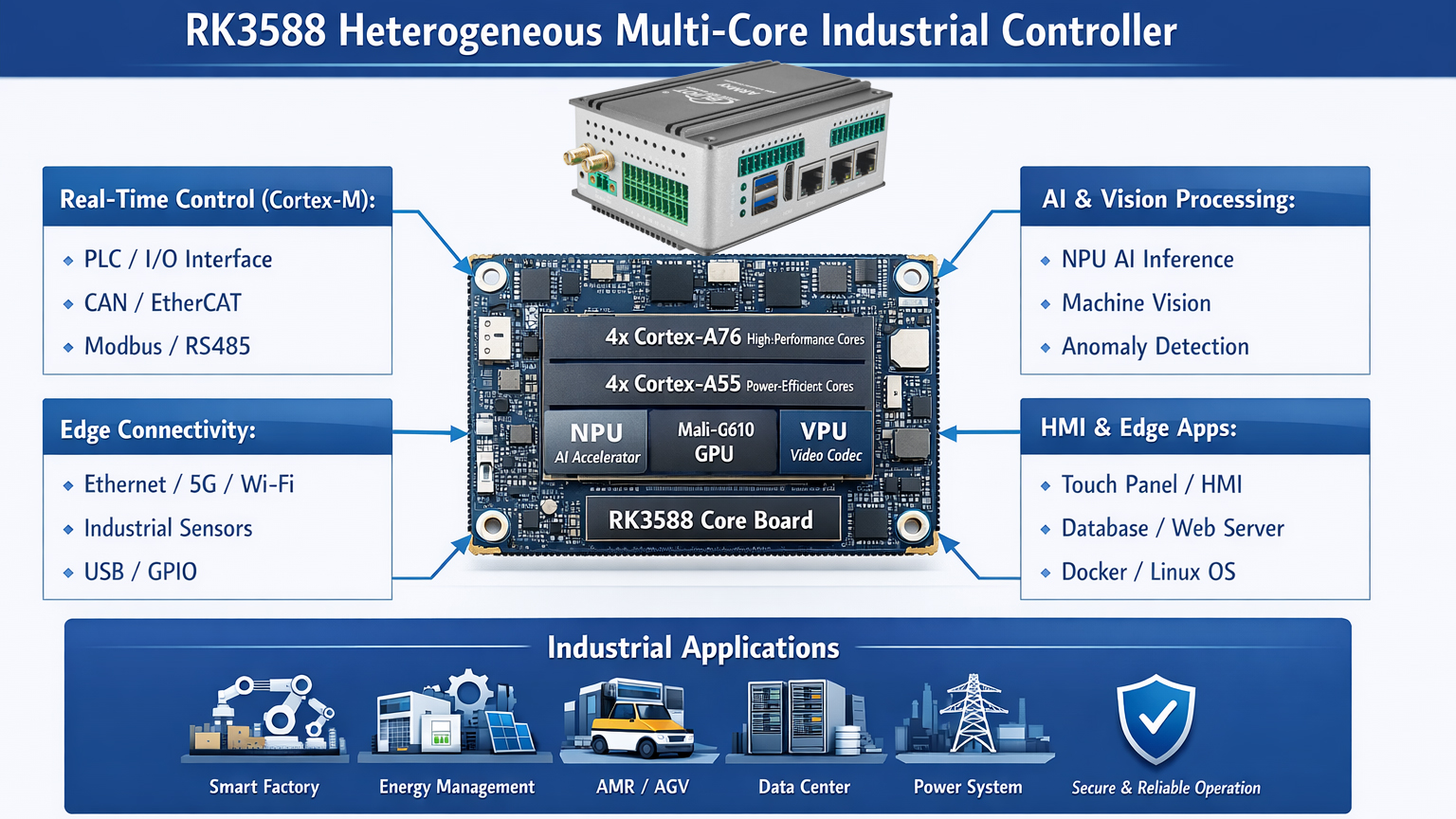
RK3588 Heterogeneous Computing Architecture
- CPU: 4 × Cortex-A76 (high-performance, up to 2.4GHz) + 4 × Cortex-A55 (high-efficiency)
- AI & Multimedia Acceleration: Independent 6 TOPS NPU (supports INT4/INT8/INT16/FP16 mixed operations)
- GPU: ARM Mali-G610 MP4
- VPU: Dedicated video codec unit (supports 8K decoding/encoding)
-
Task Allocation Example
| Task Type |
Corresponding Unit |
| AI Visual Inference |
NPU |
| Image Rendering / HMI |
GPU |
| Data Processing / App Logic |
Cortex-A76 |
| Communication / Background Services |
Cortex-A55 |
| Video Codec |
VPU |
Effects: Low-latency/low-power AI inference, smooth Linux operation, seamless multi-service parallelism.
-
Practical Value of RK3588 in Industrial and AI Edge Applications Widely used in:
- Industrial AI visual inspection
- "Dark factory" edge controllers
- Energy storage EMS / smart power systems
- Data center DCIM
- AMR/AGV control and perception fusion A single core board can replace traditional multi-device setups (controller + industrial PC + AI box).
-
Advantages Over Traditional ARM SBCs
- Higher compute density
- Lower system power consumption
- Stronger real-time and stability guarantees
- Better suited for long-term industrial deployment
Conclusion
The heterogeneous multi-core architecture of ARM core boards is redefining system design in industrial and AI edge computing. Platforms like RK3588 represent a new generation that integrates control, computing, AI, and edge intelligence into a comprehensive foundation. For industrial systems prioritizing high reliability, scalability, and long-term maintainability, heterogeneous multi-core ARM core boards have become one of the most valuable choices.
BL450 is an Industrial Edge AI Controller powered by RK3588, integrating AI inference, real-time control, and edge computing in a single platform: https://armbasedsolutions.com/products/4a76-rockchip-rk3588-arm-based-ai-edge-controller


