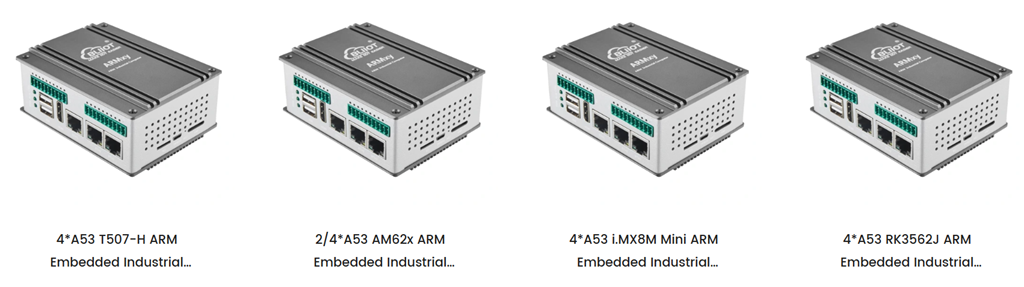
Beilai Technology ARMxy Series Industrial ARM Computers cover these commonly used quad-core ARM Cortex-A53 processor models. The BL350 adopts the TI AM6254, the BL360 series uses the i.MX8M Mini processor, and the BL370 is equipped with the RK3562J processor. Below is a detailed comparison of these three classic quad-core Cortex-A53 processors—TI AM6254, NXP i.MX8M Mini, and Rockchip RK3562J—covering key aspects such as architecture, performance, interfaces, and application scenarios.
Beilai Technology ARMxy Series Industrial ARM Computers cover these commonly used quad-core ARM Cortex-A53 processor models. The BL350 adopts the TI AM6254, the BL360 series uses the i.MX8M Mini processor, and the BL370 is equipped with the RK3562J processor. Below is a detailed comparison of these three classic quad-core Cortex-A53 processors—TI AM6254, NXP i.MX8M Mini, and Rockchip RK3562J—covering key aspects such as architecture, performance, interfaces, and application scenarios.
1. Core Parameter Comparison
| Feature |
TI AM6254 |
NXP i.MX8M Mini |
Rockchip RK3562J |
| CPU Architecture |
4x Cortex-A53 (1.4GHz) + Cortex-M4F (400MHz) |
4x Cortex-A53 (1.8GHz) + Cortex-M4 (400MHz) |
4x Cortex-A53 (1.8GHz) + Cortex-M0 (200MHz) |
| GPU |
GCN GPU (OpenGL ES 3.1) |
Vivante GC3200 (OpenGL ES 2.0) |
Mali-G52 MP2 (OpenGL ES 3.2) |
| NPU |
None |
None |
1 TOPS (lightweight AI support) |
| Video Codec |
1080p60 H.265/H.264 |
1080p60 H.265/H.264 |
4K30 H.265/H.264 |
| Industrial I/O |
CAN-FD + PRU-ICSS |
CAN-FD |
CAN 2.0B + TSN Ethernet |
| Real-Time Core |
M4F (high real-time performance) |
M4 (medium real-time) |
M0 (basic real-time) |
| Typical Power |
<3W |
2–4W |
2–4W |
2. Key Differences & Explanations
RK3562J Architecture
-
4x Cortex-A53 + Cortex-M0, where the M0 core provides basic real-time capabilities (weaker than M4/M4F), suitable for simple real-time tasks (e.g., sensor polling).
-
Limitations of M0 core:
-
No Floating-Point Unit (FPU), making real-time computation weaker than M4F.
-
Relies on software optimization for low-latency control.
Real-Time Performance Ranking
TI AM6254 (M4F+PRU) > i.MX8M Mini (M4) > RK3562J (M0)
-
PRU-ICSS (TI-exclusive) supports nanosecond-level response, ideal for demanding scenarios like motor control.
-
RK3562J’s M0 core is only suitable for non-critical real-time tasks (e.g., data acquisition).
3. Recommended Application Scenarios
| Scenario |
Recommended Processor |
Reason |
| High Real-Time Industrial Control |
TI AM6254 |
M4F+PRU-ICSS enables microsecond-level response (e.g., PLCs, servo drives). |
| Medium Real-Time HMI + Multimedia |
i.MX8M Mini |
M4 core handles UI response, while A53 runs Linux/Android. |
| Lightweight Real-Time + AI Edge Computing |
RK3562J |
M0 core processes sensor data, while 1 TOPS NPU runs algorithms like face detection. |
| Ultra-Low-Power Gateways |
TI AM6254 |
<3W power consumption + hardware-level efficiency optimization. |
4. Summary
-
TI AM6254:
Best for industrial real-time performance, but lacks AI and 4K video capabilities.
-
i.MX8M Mini:
Balances multimedia and real-time, ideal for automotive and interactive terminals.
-
RK3562J:
Cost-effective + lightweight AI, but M0 core is only suitable for non-demanding real-time scenarios (note its performance limits).
Selection Recommendations:
-
Strict real-time control → TI AM6254
-
Multimedia + medium real-time → i.MX8M Mini
-
Low-cost AI edge devices → RK3562J (avoid complex real-time tasks)

This structured comparison helps in selecting the right processor based on real-time requirements, multimedia needs, and AI capabilities.


