The 2025 Embedded World exhibition in Germany has officially kicked off, and this year, major MCU giants have once again entered a fierce competition, unveiling a plethora of innovative embedded MCUs. Texas Instruments (TI) has introduced the world’s smallest MCU—the MSPM0C1104,ST has launched the new STM32U3 microcontrollers,Renesas launching the RA4L1 MCU group, Infineon launch the RISC-V-based automotive MCUs. NXP unveiled the S32K5 MCU,Microchip unveiled the PIC32A series.
The 2025 Embedded World exhibition in Germany has officially kicked off, and this year, major MCU giants have once again entered a fierce competition, unveiling a plethora of innovative embedded MCUs. Let’s take a closer look at what each company has brought to the table.
TI: Small, Incredibly Small
Unlike other manufacturers, Texas Instruments (TI) has introduced the world’s smallest MCU—the MSPM0C1104—expanding its MSPM0 MCU product line. This MCU stands out for its size—it’s tiny, incredibly tiny. Packaged in a wafer-level chip-scale package (WCSP), it occupies just 1.38 mm², comparable to a grain of black pepper. TI claims it is 38% smaller than the current smallest MCU in the industry. To grasp just how small it is, take a look at the image below.
Despite its size, the MSPM0C1104 doesn’t compromise on performance. According to TI’s official website, it features a 24 MHz Arm Cortex-M0+ core, 1 KB SRAM, 16 KB flash memory, a power supply range of 1.62 V to 3.6 V, a 3-channel 12-bit ADC, and 6 GPIO pins. It integrates a high-speed on-chip oscillator with an accuracy range of -2% to +1.2%, eliminating the need for an external crystal. It also supports standard communication interfaces like UART, SPI, and I2C, with an operating temperature range of -40°C to 125°C.
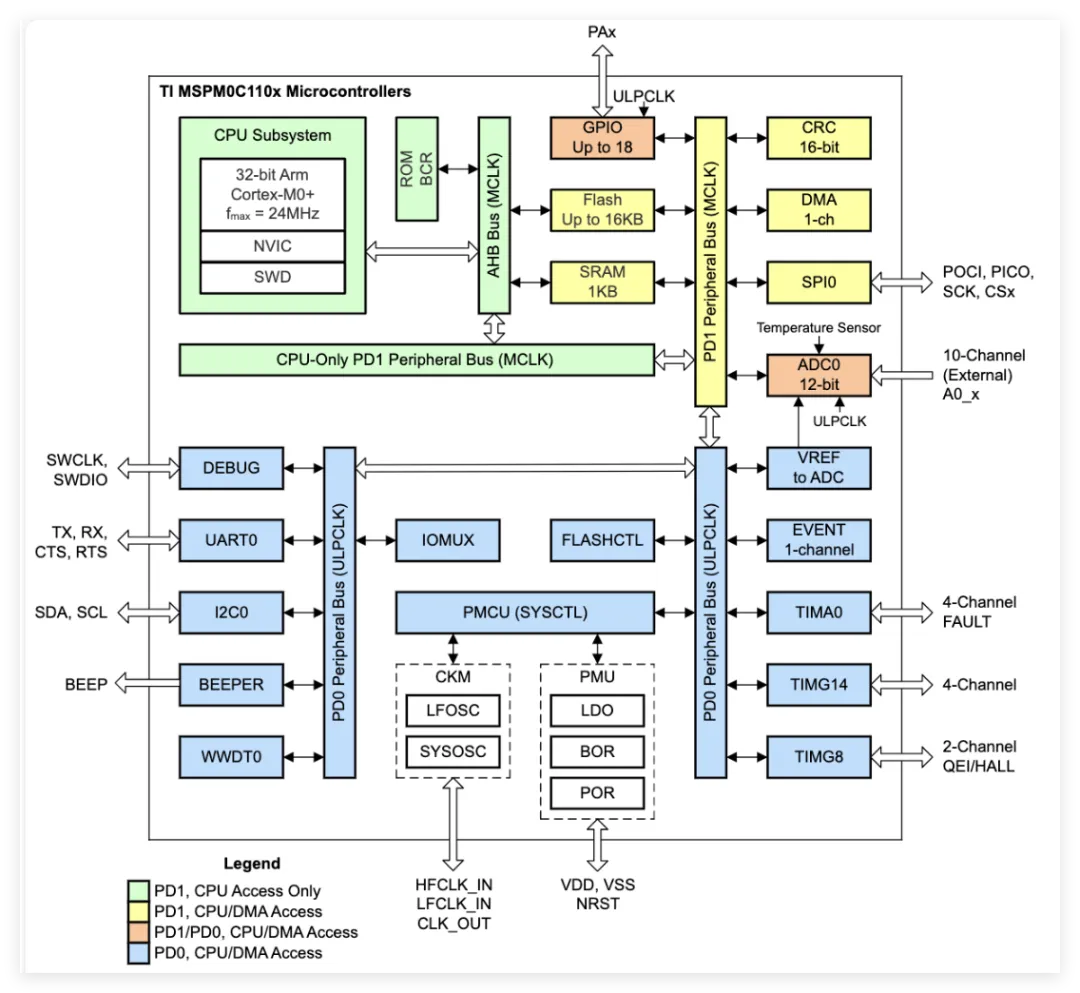
Price-wise, it’s incredibly affordable, with the product line starting at just $0.16 (for 1,000 units).
Engineers often say that in the MCU and CPU fields, the highest performance isn’t always the best—performance overkill can be wasteful. Every embedded engineer should strive to maximize the potential of their MCU. This is why compact MCUs are particularly favored in the market.
One engineer once shared with EEWorld that sometimes their requirements aren’t high, and they end up switching MCUs unnecessarily. In many cases, a 4-pin MCU could handle the task—using one external interrupt and three output pins, along with two internal timers. Of course, having a bit more resources and performance would be even better, enabling more complex functionalities.
EEWorld has also seen enthusiasts create DIY projects with compact MCUs, such as temperature and humidity displays, solar trackers, multifunctional smart aquariums, agricultural pest control lights, Bluetooth anti-loss alarms, wireless data monitoring terminals, ultrasonic rangefinders, motorcycle tire pressure alarms, indoor environmental monitors, wireless doorbells, LED strip controllers, card readers, and smart home devices.
In short, compact MCUs can handle a lot of creative ideas. TI’s new product seems ideal for scenarios with strict size constraints and relatively simple functional requirements.
ST: Focusing on Ultra-Low Power
While chip PPA (Power, Performance, Area) is the golden rule of the industry, pursuing any extreme is a product positioning strategy. While TI focuses on extreme miniaturization, STMicroelectronics (ST) is targeting ultra-low power consumption.
ST has launched the new STM32U3 microcontrollers, featuring cutting-edge energy-saving innovations to simplify the deployment of smart connected technologies, especially in remote areas.
Building on its legacy of ultra-low-power (ULP) MCUs, ST has elevated ULP performance to a new level with the STM32U3 series. Leveraging advanced energy-efficient chip design, AI-enhanced tuning tools, and the latest Arm Cortex-M33 core running at up to 96 MHz, the new MCU achieves a market-leading 117 CoreMark/mW. This is nearly twice as efficient as ST’s previous STM32U5 series and five times more efficient than the STM32L4 series.
From a technical perspective, the STM32U3 MCU utilizes near-threshold technology, operating IC transistors at extremely low voltages to achieve significant energy savings. ST’s innovative near-threshold solution employs AI-driven adaptive voltage scaling at the wafer level to compensate for process variations. In addition to dynamic power savings (as low as 10 µA/MHz), the STM32U3 series achieves an ultra-low stop current of 1.6 µA.
The STM32U3 embeds up to 1 MB of dual-bank flash memory and 256 KB of SRAM. For security, it incorporates all the successful security features of the STM32U5, along with an additional key storage function. ST loads the keys onto the STM32U3 MCU at the factory, protected by a coupling and chain bridge (CCB)—a first for the STM32 MCU series. ST also offers two product lines, with or without hardware cryptographic accelerators.
Combining its low power consumption, the STM32U3 integrates efficient and high-performance peripherals, including the latest I3C digital connectivity. It is available in commercial (-40°C to 85°C) and extended industrial (-40°C to 105°C) temperature ranges. The STM32U3 is now in production, with prices starting at $1.93 for 10,000 units.
Renesas: Also Targeting Ultra-Low Power
Renesas is also focusing on ultra-low-power MCUs, launching the RA4L1 MCU group, which includes 14 new products featuring ultra-low power consumption, advanced security, and segment LCD support. Based on the 80 MHz Arm Cortex-M33 processor with TrustZone support, these MCUs achieve industry-leading performance, functionality, and energy efficiency, offering superior solutions for water meters, smart locks, IoT sensors, and more.
The RA4L1 MCU employs proprietary low-power technology, consuming just 168 µA/MHz in active mode at 80 MHz and 1.70 µA in standby mode with all SRAM retained. It also comes in ultra-compact packages, including a 3.64 x 4.28 mm wafer-level chip-scale package (WLCSP), catering to portable printers, digital cameras, and smart labels.
The RA4L1 MCU is supported by Renesas’ Flexible Software Package (FSP), which provides all necessary infrastructure software, including multiple RTOS options, BSPs, peripheral drivers, middleware, connectivity, networking, and TrustZone support. It also includes reference software for building complex AI, motor control, and cloud solutions, accelerating application development. The FSP allows customers to integrate their existing code and preferred RTOS, offering flexibility in application development. Additionally, it simplifies the migration of existing IP across Renesas’ RA6 and RA2 series.
The RA4L1 MCU has also received PSA Level 1 certification with CRA extensions.
Infineon: RISC-V MCUs for Automotive
Recently, Infineon’s MCUs have quietly taken the lead. According to Omdia’s latest research, Infineon’s market share reached 21.3% in 2024, up 3.5 percentage points from 17.8% in 2023—the largest increase among competitors. This marks the first time in Infineon’s history that it has become the global leader in the microcontroller market. In 2023, Infineon became the world’s largest automotive MCU supplier, and now it has achieved leadership across all end markets.
At this year’s Embedded World, Infineon made another innovation—announcing the launch of RISC-V-based automotive MCUs. While Renesas also announced plans to develop RISC-V MCUs last year, Renesas focuses on general-purpose MCUs, whereas Infineon is targeting automotive-specific MCUs.
Infineon plans to release a new series of automotive-grade MCUs under the AURIX brand in the coming years, expanding its existing product portfolio based on TriCore and Arm cores.
At Embedded World, Infineon also highlighted its focus on edge AI, showcasing innovations in its PSoC multi-purpose MCU series. These include advancements in power and motor control with the new PSoC Control series, as well as edge AI solutions compliant with the EU’s Cyber Resilience Act (CRA) through PSoC Edge. Infineon particularly showcased the latest features of the PSoC 4 MCU series, which extends its leading capacitive sensing technology with new inductive and liquid sensing capabilities, enabling new use cases and higher integration.
NXP: Integrating MRAM into MCUs
In recent years, all manufacturers have been paying close attention to emerging memory technologies. For example, Infineon has introduced RRAM MCUs, and ST has launched PCM MCUs. Emerging memory technologies can effectively break through the 40 nm eFlash process bottleneck, enabling rapid advancements in process technology. Additionally, emerging memories offer superior performance, often prioritized for automotive MCUs to facilitate better OTA updates.
During Embedded World, NXP unveiled the S32K5 series of automotive microcontrollers—the first 16 nm FinFET MCUs with embedded MRAM.
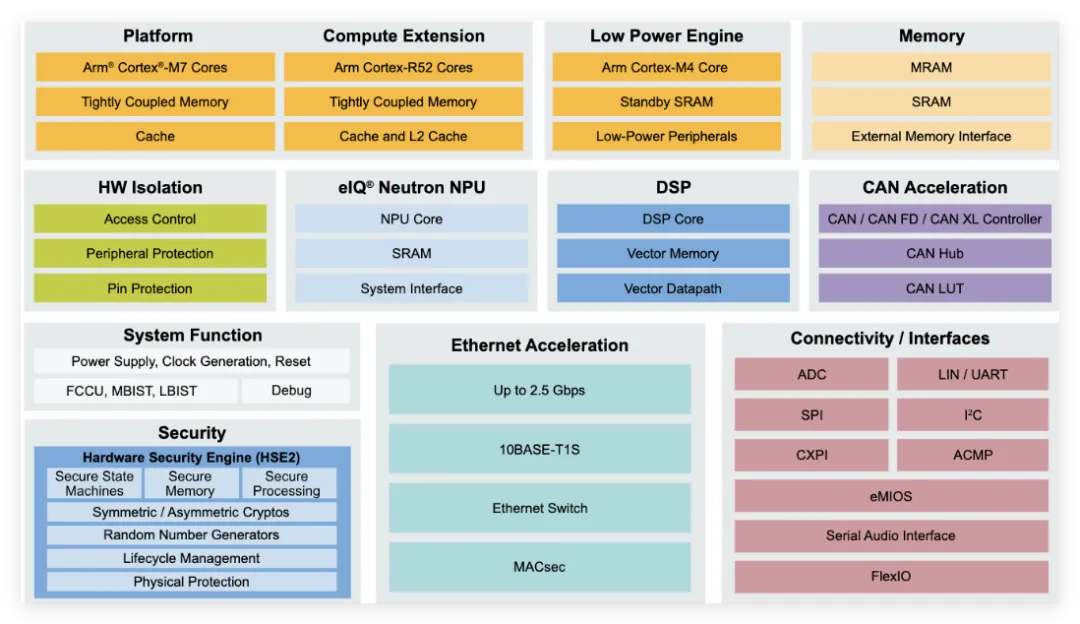
What are the benefits of MRAM? According to NXP, on-chip high-performance MRAM significantly reduces ECU programming time in factories and remote OTA update times, with write speeds 15 times faster than embedded flash. Combined with NXP’s new security accelerators, including post-quantum cryptography (PQC), the S32K5 enables automakers to securely and reliably deploy new features throughout a vehicle’s lifecycle, benefiting both manufacturers and users.
The S32K5 MCU series will expand NXP’s CoreRide platform, providing pre-integrated zonal control and electrification system solutions for scalable software-defined vehicle (SDV) architectures.
The S32K5 series features Arm Cortex CPUs running at up to 800 MHz, delivering high-efficiency performance through the 16 nm FinFET process. Optimized accelerators handle critical workloads, including network communication, information security, and digital signal processing. The S32K5 integrates an Ethernet switch core shared with NXP’s S32N automotive processors, offering a mature networking solution that simplifies design and enables software reuse.
The S32K5 series includes single-core, multi-core, or lockstep Arm Cortex-M7 and Cortex-R52 cores, operating at 200-800 MHz, along with a signal processor (DSP), up to 41 MB of MRAM, support for FOTA A/B firmware swapping, zero downtime and rollback, low-power operation and standby modes, fast wake-up, clock and power gating, and AEC-Q100 Grade 1 certification (-40°C to 125°C).
The S32K5 provides multi-layer hardware isolation, secure recovery, a hardware security engine (HSE) with post-quantum security, and ASIL D safety compliance, enabling the development of secure and reliable zonal controllers.
The S32K5 integrates a software-defined, hardware-reinforced isolation architecture, allowing automakers to achieve functional and information security partitioning, ensuring the integration of safety applications up to ASIL-D without compromising overall system safety or performance.
The S32K5 also features a dedicated eIQ® Neutron neural processing unit (NPU), NXP’s scalable machine learning accelerator, enabling high-efficiency real-time processing of edge sensor data.
Microchip: Integrating a 64-bit FPU
In recent years, Microchip’s 32-bit MCUs have become increasingly powerful. At this year’s Embedded World, Microchip unveiled the PIC32A series, featuring an integrated 64-bit FPU, offering cost-effective, high-performance solutions for automotive, industrial, consumer, and medical markets, as well as edge AI applications.
The 32-bit PIC32A MCU features a 200 MHz CPU and integrates high-speed analog peripherals, significantly reducing the need for external components. Key features include a 12-bit ADC with up to 40 Msps, a 5 ns high-speed comparator, and a 100 MHz GBWP operational amplifier, ideal for smart edge sensing. Combined with its high-performance CPU, the PIC32A enables multitasking on a single MCU, optimizing system cost and BOM.
Additionally, integrated hardware security features include ECC for flash and RAM, MBIST, I/O integrity monitoring, clock monitoring, immutable secure boot, and flash access control, providing a secure execution environment for embedded control applications.
The PIC32A MCU’s integrated 64-bit FPU efficiently handles data-intensive mathematical operations, supporting rapid deployment of model-based designs. These MCUs enable developers to accelerate execution in compute-intensive applications like sensor interfacing and data processing.
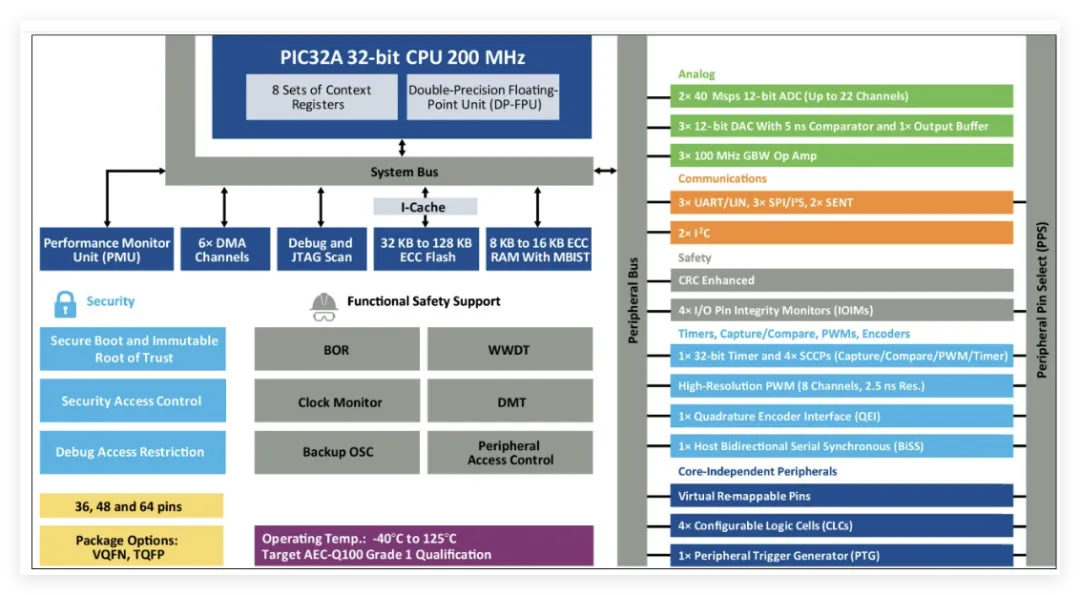
Other peripherals include three UARTs, two I2C and three SPI/I2S buses, two SENT buses, eight high-resolution PWM channels, a quadrature encoder interface, four configurable logic cells, a peripheral trigger generator, and virtual remappable pins.
Conclusion
This year’s Embedded World showcased fierce competition among industry giants, with each focusing on different themes—size, power consumption, performance, and security—while introducing numerous innovative products to meet diverse application needs.
Overall, the competition continues in three key areas: ultra-low-power MCUs, emerging memory MCUs, and edge AI MCUs. Two new trends have also emerged: automotive RISC-V MCUs and ultra-compact MCUs.


