Although both processors belong to the Cortex-A7 architecture, their market positioning shows distinct development trends. Beilai Technology's ARMxy series embedded gateways—BL310 with i.MX6ULL and BL335 with T113-i—provide users with multiple options.
Comparison between i.MX6ULL and T113: Two Classic Cortex-A7 Processors
Although both processors belong to the Cortex-A7 architecture, their market positioning shows distinct development trends. The i.MX6ULL, leveraging NXP's decades of expertise in industrial applications, continues to focus on high-reliability scenarios, with its product lifecycle management (10+ years) and low failure rate (<0.3%) earning a strong reputation in harsh industrial environments. In contrast, the T113 capitalizes on Allwinner's rapid iteration capabilities in consumer electronics, emerging as a rising star in the wave of intelligent upgrades, particularly demonstrating unique advantages in emerging fields like industrial IoT.
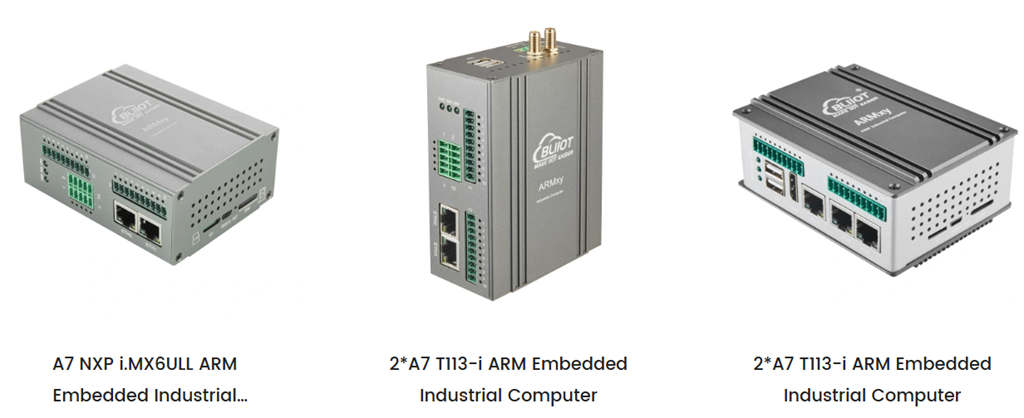
 Beilai Technology's ARMxy series ARM embedded gateways—BL310 with i.MX6ULL and BL335 with T113-i—provide users with multiple options.
1. Basic Parameter Comparison
| Feature |
i.MX6ULL (NXP) |
T113 (Allwinner) |
Brief Description |
| Core Architecture |
Single-core Cortex-A7 @900MHz |
Dual-core Cortex-A7 @1.2GHz |
T113 offers better multi-core performance |
| Process Node |
40nm |
28nm |
T113 has better power efficiency |
| GPU |
None (only 2D acceleration) |
Mali-400 MP2 |
T113 supports 3D graphics |
| Typical Power |
150mW-500mW |
100mW-2W |
T113 has lower standby power |
| Memory Support |
DDR3/LPDDR2 (256MB-512MB) |
DDR3/DDR3L/LPDDR3 |
T113 supports newer memory standards |
2. Key Differences
pie
    title Core Advantages Comparison
    "i.MX6ULL" : 45
    "T113" : 55
    "i.MX6ULL Advantages" : "Industrial reliability, rich peripherals"
    "T113 Advantages" : "Cost-performance, multimedia processing"
3. Selection Decision Tree
graph TD
    A[Project Requirements] --> B{Need graphics acceleration?}
    B -->|Yes| C[T113]
    B -->|No| D{Need industrial-grade certification?}
    D -->|Yes| E[i.MX6ULL]
    D -->|No| F[T113]
4. Recommended Scenarios
-
Choose i.MX6ULL:
✓ Industrial PLC control (-40~105°C wide temperature range)
✓ Multi-serial communication devices (8xUART)
✓ Long-term stable supply required (10+ year lifecycle)
-
Choose T113:
✓ Smart terminal devices (digital signage/educational tablets)
✓ Video surveillance edge nodes (H.264 encode/decode)
✓ Cost-sensitive projects (10-30% lower price)
5. Development Notes
Market Status
The i.MX6ULL dominates in industrial applications, while the T113 is growing rapidly in emerging smart devices. According to research, in 2023, T113's shipments in consumer electronics surpassed the i.MX6ULL, but the i.MX6ULL remains dominant in industrial markets.
This comparison highlights how these two Cortex-A7 processors cater to different market needs, with NXP focusing on industrial robustness and Allwinner targeting cost-effective multimedia applications. The choice depends on specific project requirements—whether prioritizing reliability or advanced features at a lower cost.


 Beilai Technology's ARMxy series ARM embedded gateways—BL310 with i.MX6ULL and BL335 with T113-i—provide users with multiple options.

