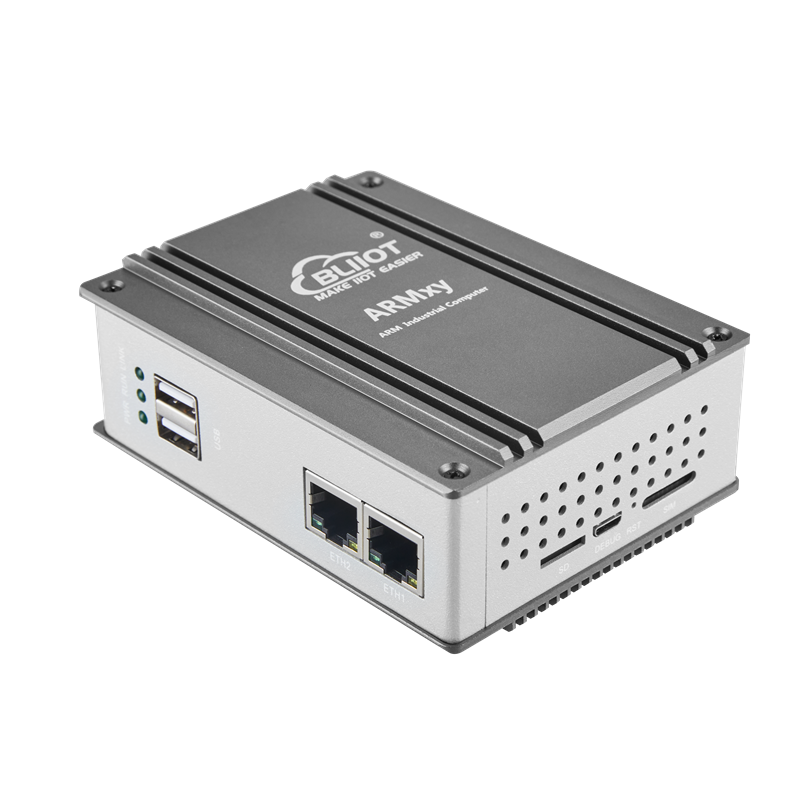
The BL330 Series is an embedded controller and industrial Control Mini Box based on the Allwinner T113-i processor, featuring a dual-core Cortex-A7 architecture, and provides configurable I/O ports and SoMs.
The ARM Based Industrial Controlle is widely used as ARM based IoT gateway, and Industrial IoT Edge Gateway in the Internet of Things (IoT) field.
The BL330 Series is an embedded controller and industrial Control Mini Box based on the Allwinner T113-i processor, featuring a dual-core Cortex-A7 architecture, and provides configurable I/O ports and SoMs.
The ARM Based Industrial Controlle is widely used as ARM based IoT gateway, and Industrial IoT Edge Gateway in the Internet of Things (IoT) field. Below are the main reasons for its popularity:
1. Balance of Performance and Low Power Consumption
2. Configurable of Interface Support
3. Highly Integrated Design
4. Support for Multiple Operating Systems
-
OS Compatibility:
-
Supports Linux, RTOS (e.g., FreeRTOS), and other operating systems.
-
Offers a rich software ecosystem and development tools.
-
Advantages:
5. Low Cost and High Cost-Effectiveness
-
Price Advantage:
-
Advantages:
6. Suitability for Various IoT Scenarios
-
Smart Home:
-
Industrial IoT (IIoT):
-
Smart Cities:
-
Advantages:
7. Strong Development Support
8. Reliability and Stability
-
Industrial-Grade Design:
-
Supports a wide temperature range, suitable for harsh environments.
-
High reliability and long lifespan, ideal for industrial applications.
-
Advantages:
Summary
The BL330, with its dual-core Cortex-A7 T113-i ARM embedded controller, is widely chosen for IoT applications due to the following reasons:
-
Balance of Performance and Low Power Consumption: Ideal for resource-constrained IoT devices.
-
Rich Interface Support: Meets diverse connectivity needs.
-
Highly Integrated Design: Reduces system complexity and cost.
-
Support for Multiple Operating Systems: Provides a flexible software development environment.
-
Low Cost and High Cost-Effectiveness: Suitable for large-scale deployments.
-
Suitability for Various IoT Scenarios: Adapts flexibly to different application needs.
-
Strong Development Support: Accelerates product development cycles.
-
Reliability and Stability: Meets high requirements for industrial and commercial applications.
These advantages make the BL330 a popular choice in the IoT field, widely used in smart homes, industrial IoT, smart cities, and more.


