AI edge controllers revolutionizes barn air quality monitoring and ventilation by addressing key challenges through real-time perception, intelligent inference, and automated controls.
Case Details
With the rapid advancement of smart livestock farming, barn environmental control is transitioning from traditional manual management to automation and intelligence. Air quality not only affects dairy cow health and milk production but also directly impacts farm economic efficiency and environmental sustainability. As a core node in intelligent farming, AI edge controllers are reshaping the technological landscape of barn air quality monitoring and ventilation management.
Challenges in Barn Air Quality Management
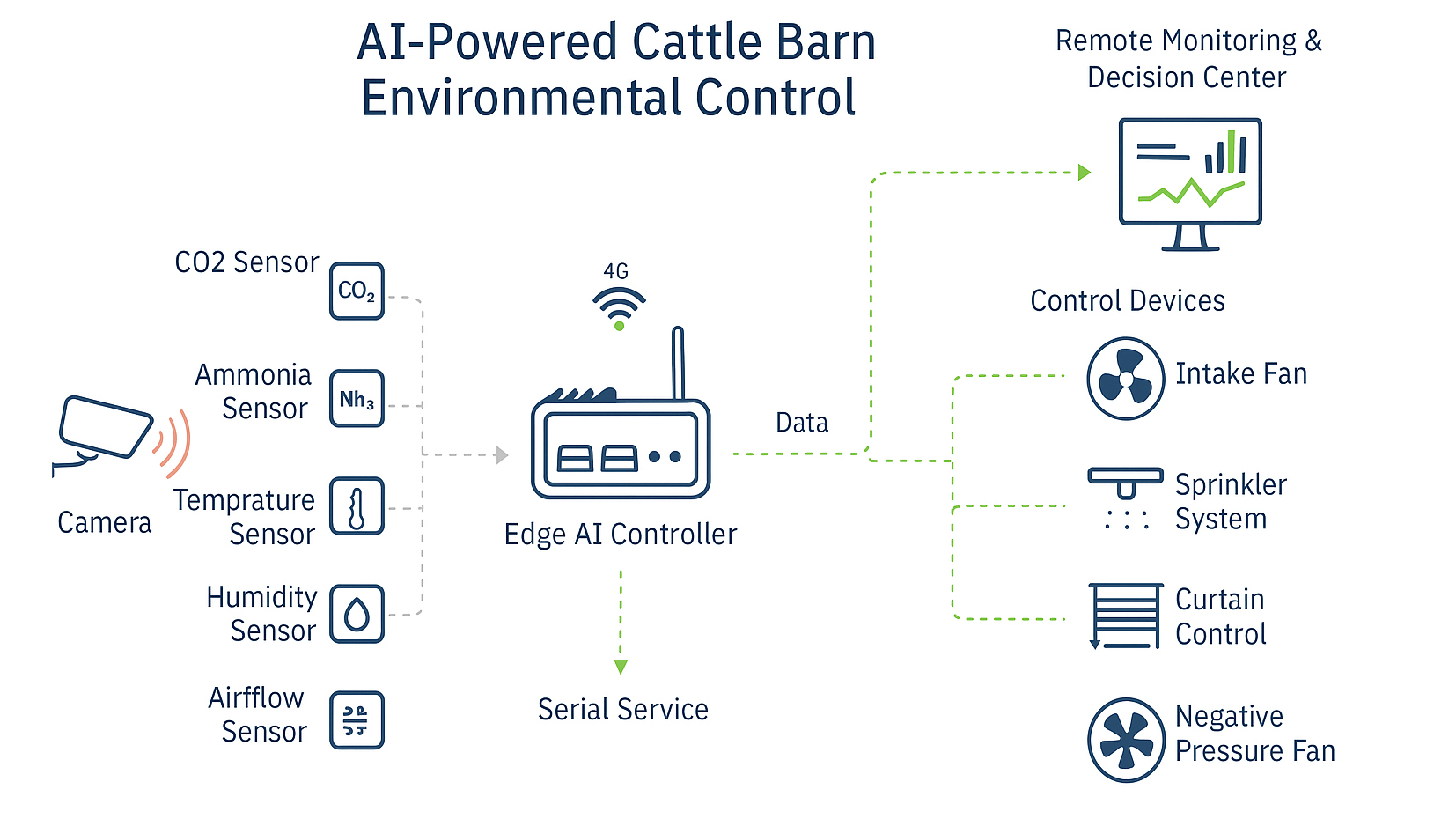
Barns typically feature large spaces with complex ventilation dynamics, and cow excretions readily generate harmful gases such as ammonia and hydrogen sulfide. Traditional ventilation systems, reliant on timed controls or manual judgment, face the following issues:
- Delayed Ventilation Response: Inability to respond in real-time to environmental changes.
- High Energy Consumption: Low operational efficiency of equipment.
- Insufficient Monitoring Precision: Difficulty in achieving precise regulation due to inaccurate air quality detection.
- Weak Disease Warning Capabilities: Inability to identify behavioral anomalies or pollution sources.
Optimization Advantages of AI Edge Controllers
AI edge controllers integrate sensor data acquisition, edge computing, intelligent control, and remote communication, offering the following key optimizations:
- Multi-Dimensional Environmental Perception
- Real-time collection of critical indicators including temperature, humidity, ammonia, CO₂, and hydrogen sulfide.
- Camera-based recognition of cow behaviors (e.g., feeding, lying down, aggregation) and abnormal states.
- Construction of a comprehensive barn environmental model to enable zoned management.
- Edge Intelligent Inference
- Local execution of AI models to detect pollution sources, heat stress risks, and behavioral anomalies.
- Millisecond-level response times, eliminating cloud latency for enhanced stability.
- Support for online model updates and self-learning, adapting to diverse farming scenarios.
- Intelligent Ventilation System Integration
- Automatic adjustment of fans, wet curtains, sprinklers, and roller shutters.
- Time-segmented and zone-specific controls to boost ventilation efficiency.
- Integration with lighting and shading systems to optimize cow comfort.
- Health Alerts and Energy Optimization
- Detection of issues like ammonia exceedance or humidity anomalies, with alarms and automated equipment activation.
- Analysis of cow behavior data to support disease warnings and feeding strategy adjustments.
- Precise control of equipment runtime and power to reduce energy consumption.
Typical Application Scenarios
| Application Scenario |
Optimization Goal |
Control Strategy |
| Summer High Temperatures |
Cooling to Prevent Heat Stress |
Activate wet curtains + fans, integrate shading curtains |
| Rising Ammonia Levels |
Reduce Respiratory Disease Risk |
Automatically engage top fans and sprinklers for dilution |
| Nighttime Low Temperatures |
Energy-Saving Cold Protection |
Reduce fan power, close partial vents |
| Cow Behavioral Anomalies |
Disease Warning |
AI detects frequent lying or reduced appetite, sends alerts |
Recommended System Architecture
| Module |
Recommended Equipment |
Function |
| Control Core |
ARM Edge Gateway (e.g., BL370) |
AI inference and equipment integration |
| Sensors |
MQ135, SHT31, CO₂ Module |
Environmental parameter acquisition |
| Ventilation Equipment |
Barn-Specific Fans, Wet Curtains, Ceiling Fans |
Automated ventilation and cooling |
| Actuators |
Electric Roller Shutters, Sprinkler Valves, Solenoid Valves |
Linked control mechanisms |
| Communication |
4G/5G, Wi-Fi |
Data transmission and remote monitoring |
Application Value and Prospects
- 🐄 Enhanced Cow Health: Improved air quality reduces disease incidence and boosts milk yield.
- ⚡ Improved Farming Efficiency: Intelligent regulation optimizes resource use and cuts operational costs.
- 📊 Data-Driven Management: Accumulated long-term data supports strategy optimization and disease prevention.
Summary
The integration of AI edge controllers revolutionizes barn air quality monitoring and ventilation by addressing key challenges through real-time perception, intelligent inference, and automated controls. This not only elevates animal welfare and productivity but also promotes sustainable, cost-effective farming practices. As AI technologies evolve, their adoption promises broader scalability across livestock operations, driving the future of precision agriculture toward greater efficiency and environmental harmony.


