ARM controllers are not only the hardware support for deep learning, but also the strategic core driving industrial intelligence. From smart terminals to industrial IoT, from automobile to healthcare.
Case Details
In the era of rapid AI advancement, deep learning has become a key driving force behind industrial automation, robotics, smart manufacturing, and IoT innovation. While traditionally associated with high-performance GPUs, an increasing number of enterprises are turning their attention to ARM-based edge controllers — efficient, cost-effective computing platforms capable of running AI inference directly on edge devices.
With continuous improvements in processor architecture and the widespread adoption of NPUs, ARM controllers are becoming the mainstream carrier for "edge deep learning," demonstrating immense potential in real-world industrial applications.
Why Are ARM Controllers Ideal for Deep Learning?
Compared to traditional x86 industrial PCs, ARM controllers offer three major advantages:
- Ultra-low Power Consumption and High Energy Efficiency Enables fanless design and stable operation in sealed, high-temperature, dusty, or battery-powered environments.
- Powerful On-device Inference Capabilities Powered by multi-core Cortex-A architectures, NEON SIMD instructions, and dedicated NPUs from vendors such as Rockchip, NXP, and Qualcomm.
- Rich Industrial I/O Integration Native support for RS485, CAN, DI/DO, multiple Ethernet variants — enabling a single device to perform both AI inference and automation control.
Thus, ARM controllers are best suited for hybrid applications combining edge inference + local closed-loop control.
Deep Learning Capabilities Enabled by ARM Controllers
- Industrial Vision AI (Edge Vision) The most widely adopted application. Paired with industrial cameras, ARM controllers become compact AI vision controllers capable of real-time execution of lightweight networks such as:
- YOLOv8n/s, YOLOv11n, YOLO-Fastest
- MobileNetV3, EfficientNet-Lite
- PP-PicoDet, RT-DETR-R18 Typical tasks include:
- Surface defect detection (scratches, dents, bubbles)
- Product counting and dimensional measurement
- Workpiece localization and robotic picking guidance
- Safety helmet/workwear compliance detection
- Barcode/QR code reading and OCR
- Equipment Condition Monitoring and Predictive Maintenance Local analysis of vibration, acoustic, current, and temperature data enables:
- Anomaly detection and early fault warning
- Remaining Useful Life (RUL) prediction Commonly used models: 1D-CNN, LSTM/GRU, Tiny Transformers, Autoencoders
- On-device Speech Recognition and Voice Control Effortlessly runs offline:
- Keyword Spotting (KWS)
- Command recognition in noisy environments
- Voice-controlled HMI panels and robotic voice interaction
- Lightweight Natural Language Processing (NLP) Capable of running BERT-Tiny, DistilBERT, etc., for:
- Alarm log classification and parsing
- Local FAQ systems
- Sentiment and intent analysis
- Hybrid OpenCV + Deep Learning Vision Algorithms The most common and robust architecture in industrial vision: Deep learning for detection/classification → OpenCV for geometric measurement and coordinate transformation → Structured output to PLC or robot
- High-Performance Inference via NPU (Rockchip Platforms)
| Model |
SoC |
NPU Compute |
Typical Performance |
| BL410 |
RK3568 |
1 TOPS |
4×720p@30fps YOLOv8n |
| BL440 |
RK3576 |
6 TOPS |
4×1080p or 1×4K multi-task |
| BL450 |
RK3588 |
6 TOPS |
8×1080p or 2×4K + multiple models |
Applicable Industries and Scenarios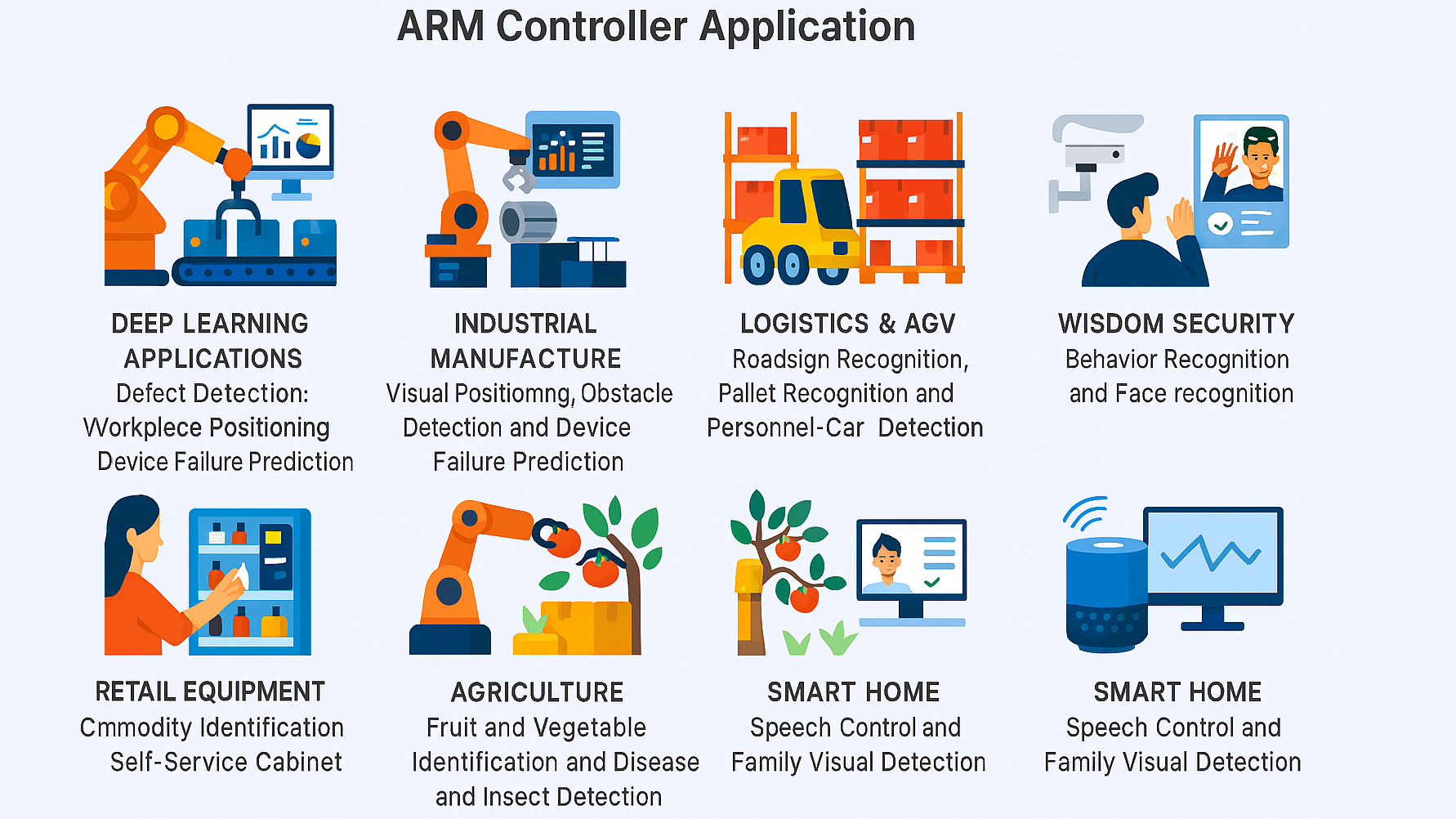
| Industry |
Typical Applications |
| Manufacturing |
Defect detection, part localization, predictive maintenance |
| Robotics |
Visual picking, obstacle avoidance, collaborative safety |
| Smart Logistics/AGV |
Pallet recognition, navigation, people-vehicle detection |
| Security & Surveillance |
Behavior analysis, perimeter protection, face recognition |
| Retail |
Product recognition, unattended cabinets, smart checkout |
| Smart Agriculture |
Fruit grading, pest & disease detection |
| Smart Home/Building |
Voice control, home security, elderly monitoring |
ARM is evolving from a supporting role to the core intelligent brain.
Why Deep Learning Must Run at the Edge
- Extremely low latency requirements (e.g., <30ms for robotic grasping)
- Unreliable or unavailable networks
- Strict data privacy and security (production data must not leave premises)
- Total cost of ownership constraints (mass deployment cannot afford GPUs)
ARM controllers achieve the optimal balance among cost, power consumption, industrial interfaces, and AI performance.
Conclusion: ARM Controllers Are Becoming the Mainstream Platform for Edge AI
ARM controllers are not designed for training large models, but they are one of the best platforms for deploying and running deep learning models.
Driven by three megatrends:
- Continuous improvement in CPU performance
- NPU becoming standard in ARM SoCs (from 1 → 6 → 20+ TOPS)
- Advances in model compression and quantization (INT8/INT4)
In the next 3–5 years, all edge devices will have built-in AI inference capabilities, and ARM controllers will be the most important carrier of this transformation.


