In the printing industry, the ARM Cortex-A53 industrial controller enables precise synchronization and intelligent control of multi-roller printing units, supporting smart manufacturing and remote maintenance through data connectivity.
Case Details
In the modern printing industry, multi-roller high-speed printing presses are widely used in packaging, labeling, publishing, and advertising. As customer demands for print quality and production efficiency continue to rise, printing equipment requires higher precision, smarter control, and more stable operation. The ARM Cortex-A53 industrial controller, with its high performance, low power consumption, and versatile interface capabilities, offers an ideal solution for printing press control systems.
Application Requirements Analysis
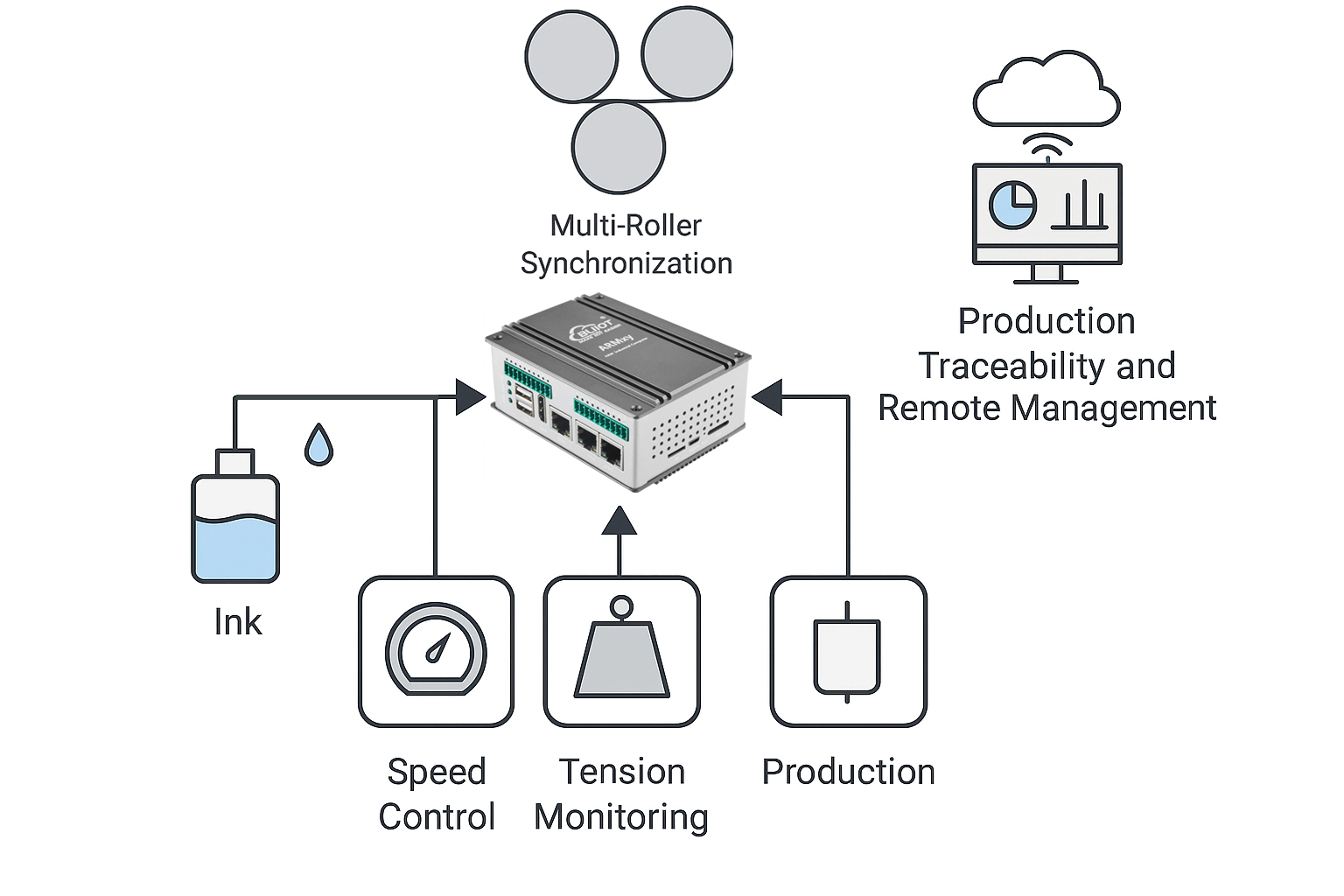
The operation of a printing press involves several critical processes:
- Multi-Roller Synchronization: Different printing units must maintain precise speed and phase alignment to ensure accurate color registration.
- Ink Management: Real-time monitoring and adjustment of ink flow, viscosity, and temperature are essential for consistent print quality.
- Speed Control: The system must ensure stable web transport speed during high-speed operation to prevent stretching or wrinkling.
- Tension Monitoring: Tension sensors monitor web conditions to avoid issues caused by excessive looseness or tightness.
- Production Traceability and Remote Management: Edge computing and network connectivity enable production data to be uploaded to MES or cloud platforms for remote diagnostics and maintenance.
- High-Performance Computing: The 64-bit architecture supports complex real-time control algorithms, enabling precise multi-roller synchronization and phase compensation.
- Multi-Bus Interfaces: Integrated Ethernet, CAN, and RS-485 interfaces facilitate seamless connectivity with servo drives, sensors, and host systems.
- Real-Time and Edge Computing: Supports Linux/RTOS dual systems, allowing efficient real-time control and local data processing with intelligent analytics.
- Low Power and High Reliability: Designed for wide temperature ranges, shock resistance, and high reliability, it meets the demands of prolonged high-speed industrial operation.
- Flexible Scalability: Supports integration with HMI interfaces, cloud platforms, and MES systems for production recipe management and big data traceability.
System Architecture and Workflow
- Main Control Unit: The ARM Cortex-A53 controller serves as the system core, managing multi-roller synchronization, ink regulation, speed, and tension control.
- Motion Control: Communicates with servo drives via CANopen to ensure high-speed, high-precision roller operation.
- Data Acquisition: Ink level sensors, viscometers, tension sensors, and high-resolution encoders collect real-time data.
- Human-Machine Interaction: Operators can configure parameters, handle alarms, and monitor production via local touchscreens or remote SCADA systems.
- Remote Connectivity: The controller uploads production data to cloud platforms, enabling remote diagnostics, preventive maintenance, and production optimization.
Application Benefits
- Improved Printing Precision: Multi-roller synchronization errors are controlled at the micrometer level, enhancing registration consistency.
- Consistent Color Quality: Automated ink parameter adjustments minimize color variations and print defects.
- Increased Production Efficiency: Supports high-speed printing, reducing downtime caused by manual adjustments.
- Reduced Operating Costs: Remote monitoring and fault prediction lower the need for manual inspections and maintenance.
- Support for Smart Manufacturing: Integration with MES and cloud platforms enables intelligent, data-driven printing production systems.
Conclusion
The ARM Cortex-A53 industrial controller provides a high-performance, flexible, and reliable solution for the printing industry, achieving precise synchronization and intelligent control of multi-roller printing units while supporting smart manufacturing and remote maintenance through data connectivity. As the printing industry moves toward higher speeds and greater intelligence, ARM-based controllers will play an increasingly vital role in printing and packaging equipment.


