ARM Cortex-A7 edge gateway offers low power consumption, high cost-performance, and flexible protocol support, providing an efficient and reliable solution for building energy management systems.
Case Details
With the rise of smart buildings and green architecture, Energy Management Systems (EMS) have become a cornerstone of building operations. By collecting, monitoring, and optimizing data from electricity, water, gas, and other energy sources, EMS enables managers to reduce energy costs, improve equipment efficiency, and manage carbon emissions. In this context, edge computing gateways play a pivotal role.
The ARM Cortex-A7 edge gateway BL330 series, with its low power consumption, cost-effectiveness, and versatile interfaces, is an ideal choice for building energy management. It supports localized data collection and processing, provides energy consumption visualization, and securely interacts with EMS platforms or cloud systems via reliable network protocols.
Application Architecture and Features
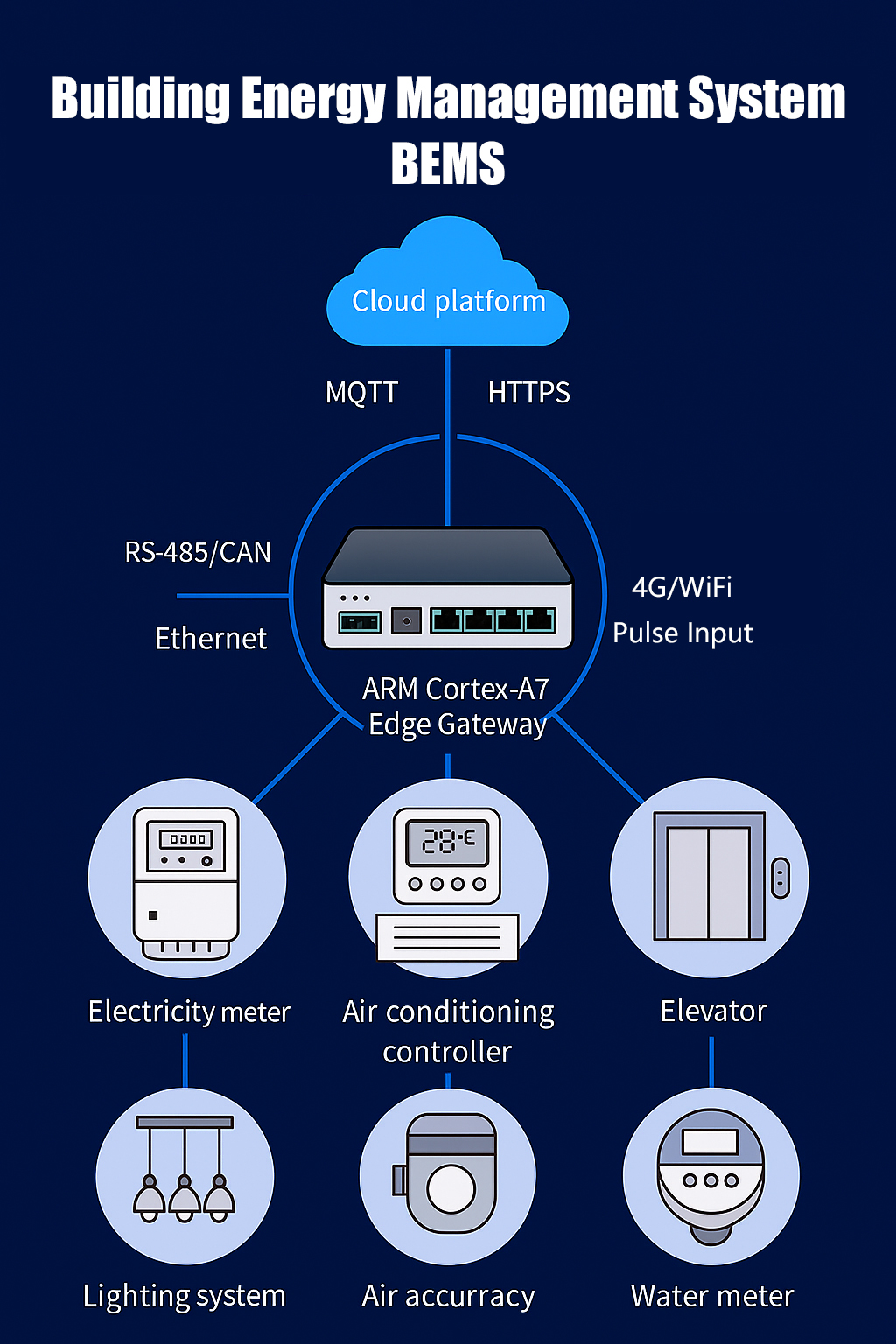
- Zonal Energy Collection
- Connects to electricity, water, and gas meters via RS485, RS232 or pulse input interfaces.
- Enables multi-dimensional energy management by zone, floor, or tenant.
- Local Processing and Edge Computing
- Performs denoising, calibration, and aggregation of collected data, supporting minute-level, hourly, and daily statistics.
- Offers local threshold monitoring and anomaly detection for real-time alerts.
- Visualization and Analysis
- Features a lightweight Web UI for viewing energy trends and comparative reports within a local network.
- Provides unified visualization and usage analysis for electricity, water, and gas.
- Data Reporting and Protocol Conversion
- Converts traditional building protocols (e.g., Modbus, BACnet) to MQTT, HTTP, or OPC UA.
- Uploads data to central EMS servers or cloud platforms via Ethernet, Wi-Fi, or 4G/5G.
- Security and Maintenance
- Supports TLS encryption, VPN tunnels, and device certificate authentication for secure data transmission.
- Enables remote maintenance and OTA upgrades for easy updates and scalability.
Typical Application Scenarios
- Commercial Buildings: Manages electricity and water consumption by floor or tenant for fair billing.
- Hospitals and Schools: Monitors energy usage in critical areas to ensure power stability and optimize consumption.
- Data Centers: Accurately collects cooling and power consumption data to support Power Usage Effectiveness (PUE) calculations and optimization.
- Large Complexes: Integrates hundreds of metering points to provide a comprehensive view of energy consumption, aiding energy conservation and emission reduction.
Deployment Benefits
- Reduced Operational Costs: Edge computing minimizes cloud dependency, saving bandwidth and storage costs.
- Enhanced Real-Time Performance and Reliability: Local gateways cache data and trigger alerts during network disruptions.
- Improved Energy Transparency: Zonal visualization and benchmarking help identify energy-saving opportunities.
- Support for Carbon Reduction and Compliance: Provides granular energy data to meet ESG and carbon audit requirements.
Conclusion
The ARM Cortex-A7 edge gateway, with its low power consumption, cost-effectiveness, and flexible protocol support, offers an efficient and reliable solution for building energy management systems. It enables zonal energy collection, visualization, and supports advanced analysis, energy optimization, and intelligent maintenance. In the era of smart buildings and green architecture, the ARM edge gateway is a critical enabler of energy digitization.


