ARM edge computing gateway provides efficient, reliable, and secure operation for charging stations through local aggregation, business logic, and energy management, making it particularly suitable for future integrated photovoltaic-energy storage-charging applications.
Case Details
With the rapid growth of electric vehicle (EV) adoption, small and medium-sized charging stations are becoming increasingly common. Operators face the challenge of ensuring an optimal charging experience while achieving efficient energy utilization and minimizing electricity costs. Traditional cloud-based centralized management systems suffer from high latency, network dependency, and excessive data processing demands. The ARM edge computing gateway offers a novel solution to these challenges.
In EV charging scenarios, the ARM edge computing gateway serves as a local "edge server," performing three core functions: data collection, business logic processing, and energy management:
-
Local Data Aggregation: Collects data from charging piles, main meters, photovoltaic (PV) inverters, and energy storage systems, performs preliminary processing and aggregation, and uploads it to the cloud, reducing the cloud platform's workload.
-
Local Business Logic: Maintains basic station operations during brief network outages, including order caching, rate mirroring, and charging record management, ensuring uninterrupted service.
-
Local Energy Management: Acts as a real-time energy flow scheduling center in a microgrid comprising PV, storage, and charging piles, enabling peak shaving, valley filling, demand control, and self-consumption optimization.
System Functions and Value
Energy Consumption Data Collection and Aggregation
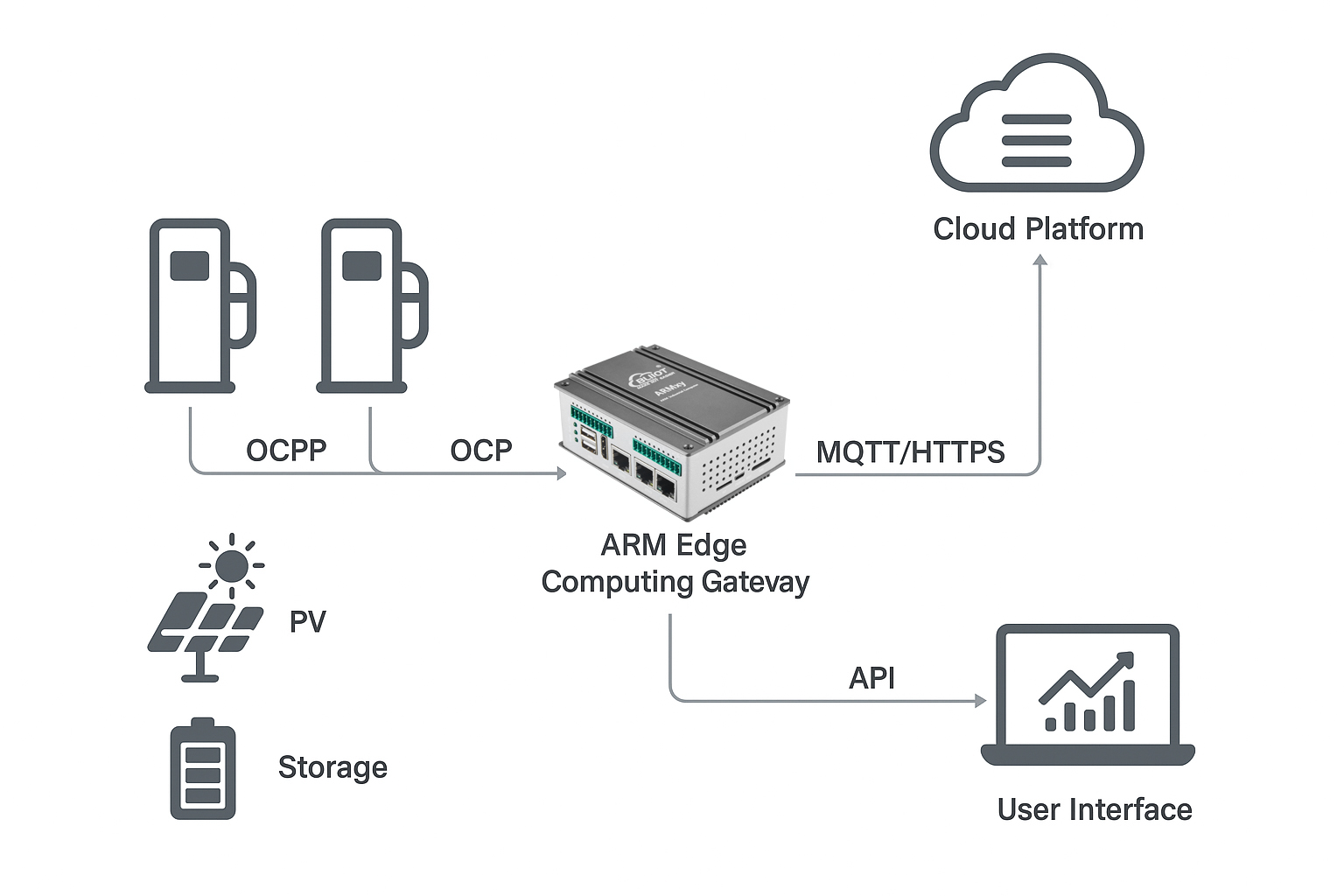
The gateway collects operational data from charging piles (power, energy, status), PV generation, energy storage battery SOC, and station-level meter data via Ethernet, 4G/5G, or RS-485 interfaces. It performs local data cleaning and compressed storage, reducing cloud storage and computing demands while improving data transmission efficiency.
Business Continuity During Network Outages
The ARM gateway features an order and session caching mechanism, enabling real-time local billing and temporary storage of charging sessions. Even during network interruptions, it supports user charging transactions and bill generation. Once connectivity is restored, cached data is automatically synced to the cloud, ensuring data integrity.
Integrated Photovoltaic-Storage-Charging Energy Management
In charging stations equipped with PV and energy storage systems, the ARM gateway functions as a local Energy Management System (EMS):
-
PV Prioritization: Locally generated PV power is prioritized for charging piles, with surplus energy used to charge storage systems.
-
Storage Regulation: Discharges during peak electricity price periods to reduce grid demand and costs; charges during off-peak periods to achieve peak shaving and valley filling.
-
Orderly Charging: Dynamically allocates charging power based on station power limits and transformer capacity, ensuring operational safety and efficiency.
Security and Reliability
The ARM edge gateway supports bidirectional TLS communication, certificate authentication, and local whitelisting to secure data and control links. Its industrial-grade hardware design and power outage protection ensure stable operation in harsh environments.
Application Value
-
Cost Reduction: Peak shaving, valley filling, and PV-storage coordination significantly lower electricity expenses.
-
Enhanced User Experience: Uninterrupted charging services during network outages ensure a seamless experience for EV users.
-
Improved System Reliability: Edge-cloud collaboration enables rapid response and data integrity.
-
Scalable Flexibility: Supports integration of additional charging piles, storage units, and sensors to meet the needs of charging stations of varying scales.
Conclusion
The ARM edge computing gateway is more than a data collection and transmission relay; it is an intelligent local control hub. Through local aggregation, business logic, and energy management, it provides efficient, reliable, and secure operations for charging stations, making it particularly suitable for future integrated photovoltaic-storage-charging applications.


