ARM Edge controllers propels DAS from manual monitoring to intelligent autonomy, dramatically improving power supply reliability and response speed. This provides a robust foundation for smart power systems and the energy Internet of Things.
Case Details
In modern smart grids, the Distribution Automation System (DAS) serves as a critical component for ensuring power supply reliability and energy quality. With the increasing complexity of distribution networks and the growing integration of distributed energy resources, traditional centralized control architectures fall short in meeting real-time response and self-healing requirements. The ARM edge controller emerges as an efficient, autonomous solution, significantly enhancing the intelligence of the system.
System Architecture and Functions
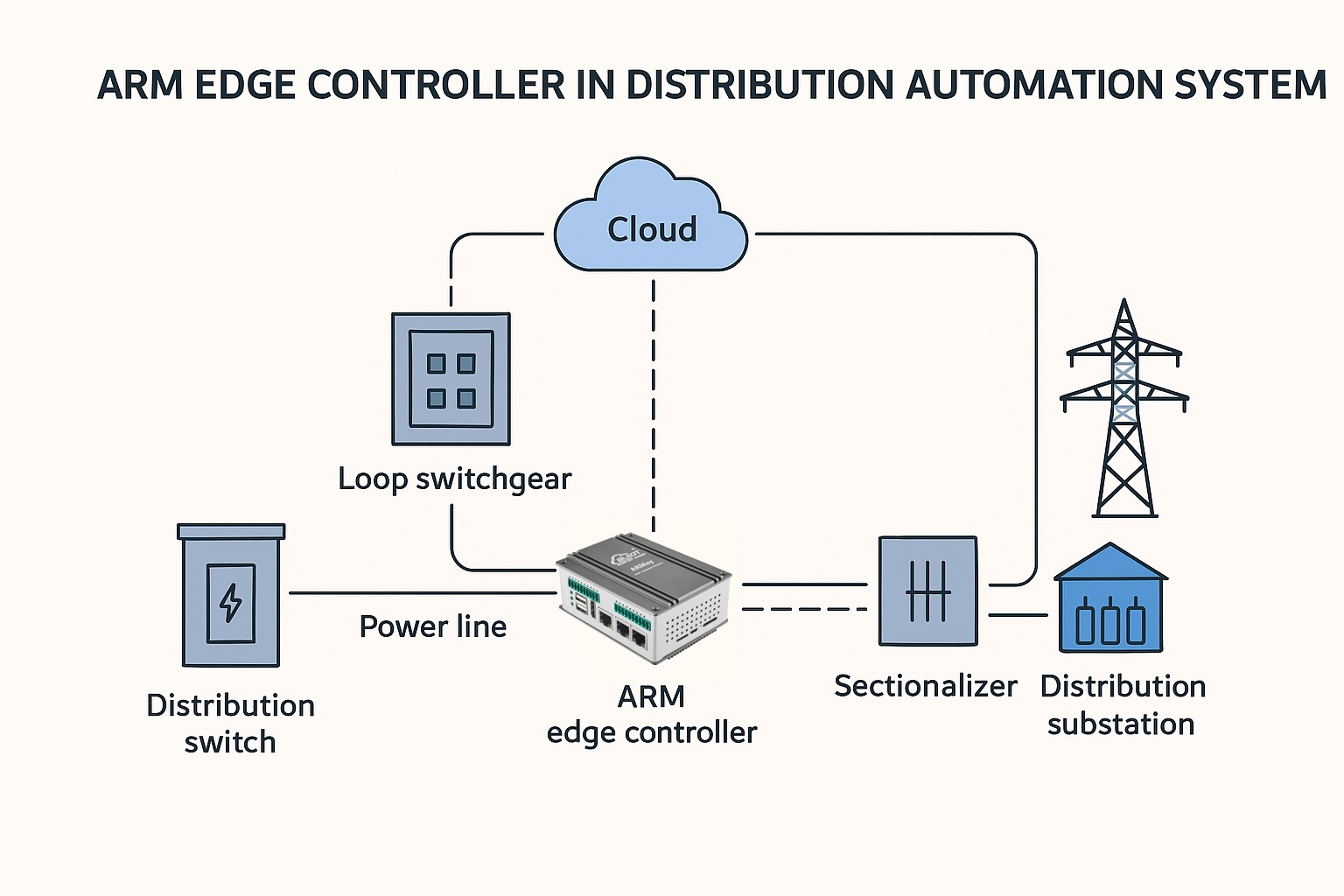
The ARM edge controller BL370 Series is deployed at key nodes in the distribution network (such as switching stations, ring main units, and sectionalizers), handling on-site monitoring, control, and communication. Leveraging integrated local AI and edge computing capabilities, the controller independently manages data acquisition, event analysis, and action execution, enabling rapid responses without reliance on the central master station.
Key functions include:
- Equipment Monitoring: Real-time collection of critical parameters such as current, voltage, temperature, and position status from distribution switches, ring main units, sectionalizers, and other devices, ensuring transparent operational visibility.
- Fault Detection and Localization: AI algorithms identify anomalies like short circuits, ground faults, and overloads, while precisely locating the faulty section to improve diagnostic efficiency.
- Automatic Isolation and Power Restoration: Upon fault detection, the controller swiftly actuates sectionalizing switches for isolation and dynamically reconfigures power paths, achieving system self-healing.
- Communication and Remote Management: Supports protocols including IEC 60870-5-104, Modbus, and MQTT for seamless integration with dispatch master stations and cloud platforms.
- Data Analysis and Edge Intelligence: Local storage of historical data with operational trend analysis, providing intelligent decision support for maintenance.
Technical Advantages
- High-Performance, Low-Power ARM Architecture: Suitable for long-term stable operation in outdoor power environments, reducing energy consumption and enhancing reliability.
- Edge AI for Rapid Response: Enables millisecond-level fault detection and control actions, surpassing traditional system speeds.
- Modular I/O Design: Flexibly accommodates various power equipment and sensors for easy on-site expansion and customization.
- Multi-Protocol Interoperability: Compliant with industry-standard communication protocols, facilitating high-compatibility system integration.
- Local Autonomy with Cloud Collaboration: Operates independently during communication outages to ensure power continuity, while supporting cloud-based data sharing.
Typical Application Scenarios
- Urban Ring Main Unit Automation and Self-Healing System: Real-time monitoring and rapid fault recovery for urban distribution networks, enhancing power resilience.
- Industrial Park Distribution Monitoring and Zonal Management: Fine-grained zonal control to optimize industrial load distribution and minimize outage impacts.
- Rural Distribution Line Intelligent Switch Control: Ideal for remote areas, enabling remote smart operations and reducing maintenance costs.
- Intelligent Reconstruction of Distribution Networks with Distributed Power Integration: Dynamically adapts to renewable sources like photovoltaics and wind power, enabling grid reconfiguration and balance.
Conclusion
The deployment of ARM edge controllers propels DAS from manual monitoring to intelligent autonomy, dramatically improving power supply reliability and response speed. This provides a robust foundation for smart power systems and the energy Internet of Things.


