From rule-based algorithms to deep learning, and now to hybrid models and self-learning systems, industrial vision inspection is undergoing a profound transformation.
Case Details
In the wave of smart manufacturing and industrial automation, vision inspection has become the core of quality control. It not only identifies defects but is evolving into a key tool for production optimization and intelligent decision-making.
Traditional Vision: Rule-driven Stability
Early industrial vision systems relied on rule-based algorithms, where features were manually defined. Common methods include:
-
Thresholding: Distinguishing bright/dark regions for scratch or bubble detection
-
Edge Detection: Identifying contours and crack directions
-
Template Matching: Comparing with standard images to locate defects
-
Morphological Processing: Noise removal, dilation, erosion for target extraction
-
Blob/Connected Component Analysis: Measuring area, position, and shape parameters
Advantages: High interpretability, fast processing, stable performance Limitations: Sensitive to lighting/reflection, poor accuracy for complex defects
Traditional vision is like a “craftsman”—precise but inflexible.
Deep Learning: Enabling Algorithms to “Understand” Defects
With the rise of GPU computing, deep learning brought true visual intelligence to industrial inspection. Instead of relying on manual rules, it learns from large datasets to distinguish normal from defective patterns.
Main approaches include:
-
Classification Models: Determine whether an image contains defects
-
Segmentation Models (UNet, DeepLab): Pixel-level defect labeling
-
Detection Models (YOLO, Faster R-CNN): Bounding box localization
-
Unsupervised/Self-supervised Models (AE, GAN, Diffusion): Detect anomalies via distribution shifts
Advantages: Strong recognition of complex textures and micro-defects, adaptable to diverse scenarios Limitations: High data dependency, long training cycles, low interpretability
For example, in metal surface inspection, deep learning can identify scratches, dents, and pits. But with insufficient samples or sudden changes, it may misclassify new defects as normal.
Hybrid Models: The Fusion of Rules and AI
To balance stability and intelligence, hybrid models have become mainstream. Typical architectures include:
-
Rule Pre-filtering + AI Recognition: Rules remove background or extract ROI, AI performs fine classification
-
AI Detection + Rule Validation: AI identifies defects, rules verify dimensions and logic
-
Ensemble Models: Multiple models run in parallel, results fused—ideal for high-precision scenarios
Hybrid models enable fast deployment and dynamic optimization, widely applied in battery electrodes, chips, and welding inspection.
Key Challenges in Engineering Deployment
In practice, engineers face several challenges:
-
Data Imbalance: Defect samples are scarce → Data augmentation, GAN-generated samples
-
High Annotation Cost: Manual labeling is time-consuming → Semi-supervised/active learning
-
Real-time Requirements: Deep models are computationally heavy → Model pruning, TensorRT optimization, edge inference
-
Poor Interpretability: Clients demand reasoning → Grad-CAM, feature heatmaps
Successful deployment depends not on the strongest algorithm, but on the one best suited to production conditions, cycle time, and cost.
Future Trends: From Recognition to Cognition
Industrial vision inspection is advancing toward cognitive intelligence. Future directions include:
-
Few-shot Learning: Recognize new defects with only a few samples
-
Online Learning: Optimize models during production
-
Multimodal Fusion: Combine vision, force, and acoustic signals for joint judgment
-
AI Agent Decision Systems: Automatically decide when to alert, recheck, or adapt
Inspection systems will no longer just “find problems”—they will actively “learn to improve.”
BL450: The Ideal Platform for AI Vision Inspection
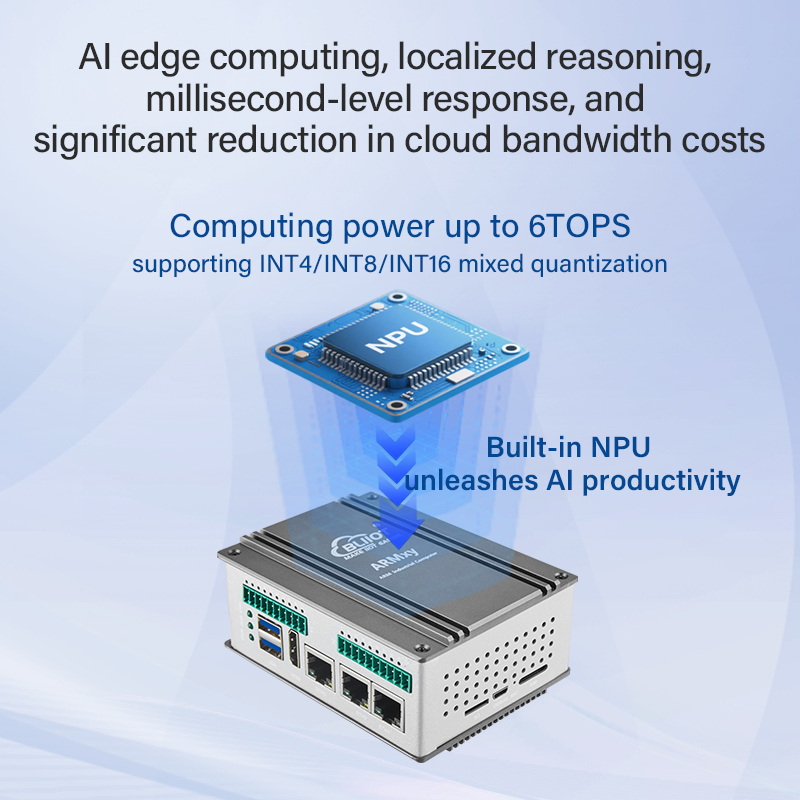
Alongside algorithm evolution, hardware platforms are equally critical. Beilai Technology’s BL450 AI Edge industrial computer, based on the RK3588 octa-core processor, offers significant advantages:
-
Powerful Computing: Integrated CPU + NPU for real-time deep learning inference
-
Multimodal Support: Handles image, video, and sensor data simultaneously
-
Rich Interfaces: Multi-camera input, Gigabit Ethernet, USB, for industrial deployment
-
AI Ecosystem Compatibility: Native support for TensorRT, OpenCV, PyTorch, ONNX frameworks
-
Industrial-grade Reliability: Wide temperature range, low power consumption, robust design
With these features, BL450 not only supports hybrid vision detection but also enables high-precision, low-latency AI vision inspection, making it an ideal choice for upgrading industrial inspection systems.


