AI edge computing framework revolutionizes wheat yield prediction by leveraging ARM-based hardware for efficient local processing, multi-source data fusion, and seamless edge-cloud integration.
Case Details
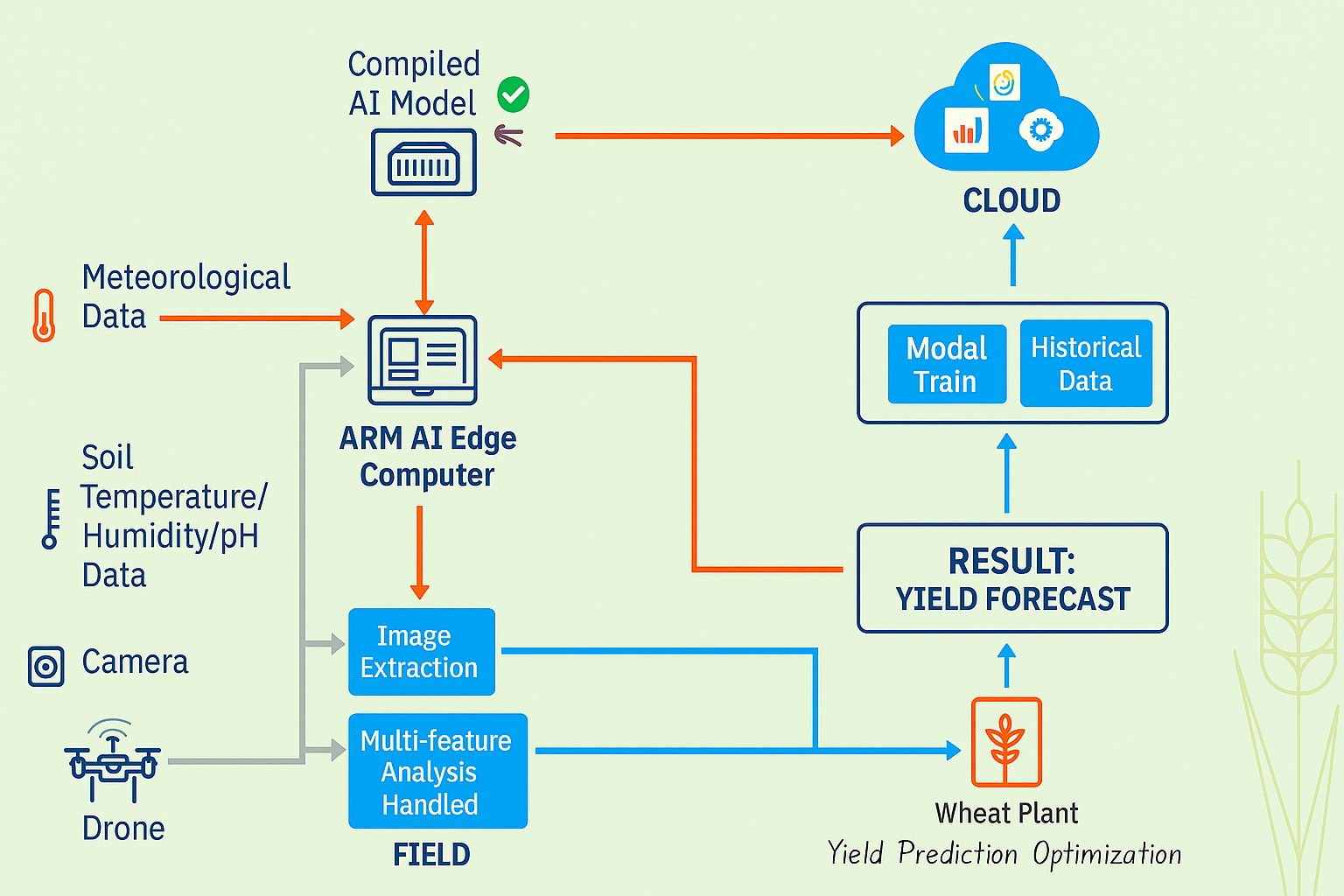
In the context of global food security and sustainable agricultural development, enhancing the accuracy and responsiveness of wheat yield predictions has become a critical challenge in modern farming. This article proposes an optimized solution based on ARM architecture AI edge computers, integrating multi-source data acquisition, intelligent model inference, and edge-cloud collaboration mechanisms to enable "visualized, intelligent, and efficient" management in wheat cultivation.
System Architecture Design
Edge Hardware Platform
- Device Selection: Utilizes RK3576 edge computers BL440 series equipped with an integrated NPU (6 TOPS) for local AI inference.
- Interface Configuration: Integrates RS485, CAN bus, dual Gigabit Ethernet ports, and Wi-Fi/4G modules to connect with agricultural sensors, PLCs, cameras, and other devices.
- Deployment Mode: Supports DIN rail mounting for field adaptability, with dustproof and waterproof capabilities to withstand harsh environmental conditions.
Software Architecture
- Edge Layer: Runs Ubuntu + Docker, deploying ThingsBoard Edge instances for data acquisition, rule engine processing, and local visualization.
- Cloud Layer: Hosts ThingsBoard Cloud or private clouds for model training, historical data analysis, and cross-regional management.
Data Acquisition and Processing Workflow
| Data Type |
Source Device |
Acquisition Frequency |
Processing Method |
| Soil Data |
Humidity, temperature, pH sensors |
Hourly |
Real-time edge processing |
| Meteorological Data |
Weather stations or APIs |
Daily |
Cloud aggregation analysis |
| Image Data |
Cameras/drones |
Daily/weekly |
CNN feature extraction |
| Farm Records |
Manual entry/APP |
Real-time |
Cloud synchronization |
AI Yield Prediction Model Construction
Model Structure
- Image Recognition Module: Employs CNN to extract crop growth features (e.g., Leaf Area Index, NDVI).
- Time Series Module: Uses LSTM/RNN to analyze trends in meteorological and soil data.
- Fusion Prediction Module: Applies GBDT or XGBoost to integrate multi-dimensional data and output yield predictions.
Model Advantages
- High Accuracy: Prediction errors controlled within ±5%.
- Adaptability: Dynamically adjusts forecasts based on real-time data.
- Interpretability: Provides feature importance analysis to support agronomic decision-making.
Application Scenarios and Value Realization
| Application Scenario |
Functionality Implemented |
Value Enhancement |
| Precision Fertilization |
Formulates fertilization plans based on predicted yields and soil conditions |
Reduces costs, improves quality |
| Intelligent Irrigation |
Automatically adjusts irrigation frequency using meteorological and soil data |
Saves water, boosts yields |
| Agricultural Insurance |
Supplies objective yield data for claims assessment |
Mitigates risks |
| Sales Planning |
Forecasts yields in advance to optimize sales and logistics |
Minimizes overstock, increases profits |
Deployment and Operations Recommendations
- Model Training: Initial training on the cloud, followed by deployment to the edge for inference.
- Data Synchronization: Uses MQTT protocol for edge-cloud data sync, with offline resumption capabilities.
- Visualization Platform: Leverages ThingsBoard Dashboard to display real-time data, predictions, and alerts.
- Operations Mechanism: Enables remote OTA upgrades, device status monitoring, and fault alerts.
Future Expansion Directions
- Integrate satellite remote sensing data to enhance regional prediction capabilities.
- Incorporate blockchain for credible storage and verification of farm activity data.
- Link with agricultural machinery for prediction-driven automated operations.
Summary
This optimized AI edge computing framework revolutionizes wheat yield prediction by leveraging ARM-based hardware for efficient local processing, multi-source data fusion, and seamless edge-cloud integration. By achieving high-precision forecasts (±5% error), it empowers precision agriculture applications like targeted fertilization and irrigation, ultimately driving cost savings, resource efficiency, and profitability while paving the way for scalable, sustainable farming innovations.


