In BESS, communication is the core enabler for ensuring safe, stable, and efficient system operation. Among various communication protocols, the Controller Area Network (CAN) bus has emerged as the standard interface for interconnecting the Battery Management System (BMS), Power Conversion System (PCS), and Energy Management System (EMS).
Case Details
With the rapid development of renewable energy sources, electrochemical Battery Energy Storage Systems (BESS) have become essential components of modern power systems. BESS plays a critical role in peak shaving and valley filling, emergency backup power, as well as in microgrids, distributed energy resources, and smart grids.
In BESS, communication is the core enabler for ensuring safe, stable, and efficient system operation. Among various communication protocols, the Controller Area Network (CAN) bus has emerged as the standard interface for interconnecting the Battery Management System (BMS), Power Conversion System (PCS), and Energy Management System (EMS).
Hierarchical Communication Architecture of BESS
A complete BESS typically consists of multiple hierarchical layers:
- Cell: The fundamental energy storage unit.
- Module: Composed of multiple cells.
- Rack/Cluster: Multiple modules connected to a Battery Monitoring Unit (BMU).
- Battery Management System (BMS): Monitors and protects the entire battery cluster.
- Power Conversion System (PCS): Controls charging/discharging and interfaces with the grid.
- Energy Management System (EMS): Handles energy scheduling and remote monitoring.
In this multi-layer architecture, information must be transmitted rapidly between different control units, including:
- Monitoring parameters such as voltage, current, temperature, State of Charge (SOC), and State of Health (SOH).
- Charging/discharging commands, alarms, and protection signals.
- System operational status and energy control instructions.
This environment is where the CAN bus excels, providing robust and efficient data exchange.
Technical Advantages of CAN Bus in BESS
The CAN bus offers several key advantages tailored to the demanding requirements of BESS:
| BESS Requirement |
CAN Bus Feature |
Explanation |
| High Reliability |
Differential signaling + redundancy checks |
Ensures stable communication in high-voltage, high-current environments |
| Multi-Node Support |
Accommodates hundreds of nodes |
Enables shared bus access for multiple BMS clusters, PCS, and EMS |
| Strong Real-Time Performance |
Arbitration mechanism prioritizes high-priority messages |
Fault alarms uploaded in milliseconds |
| Fault Tolerance |
Automatic retransmission and error isolation |
Single-node failures do not disrupt the entire network |
| Low Cost and Simple Wiring |
Only two signal lines (CAN_H, CAN_L) |
Reduces installation costs |
| Standardized Interface |
ISO 11898 international standard |
Broad compatibility with various BESS equipment |
Typical CAN Communication Architecture in BESS
The CAN bus forms the backbone of data flow in a typical BESS setup, as illustrated below:
text
[Battery Module] ─┐
[Battery Module] ─┼──> CAN Bus ───> [BMS Controller] ───> [PCS] ───> [EMS / Cloud]
[Battery Module] ─┘
Key data flows include:
- BMU → BMS: Uploads individual cell voltages, temperatures, and balancing information.
- BMS → PCS: Transmits current limits, protection commands, and status updates.
- PCS ↔ EMS: Supports energy scheduling and remote monitoring via CAN or Modbus-TCP.
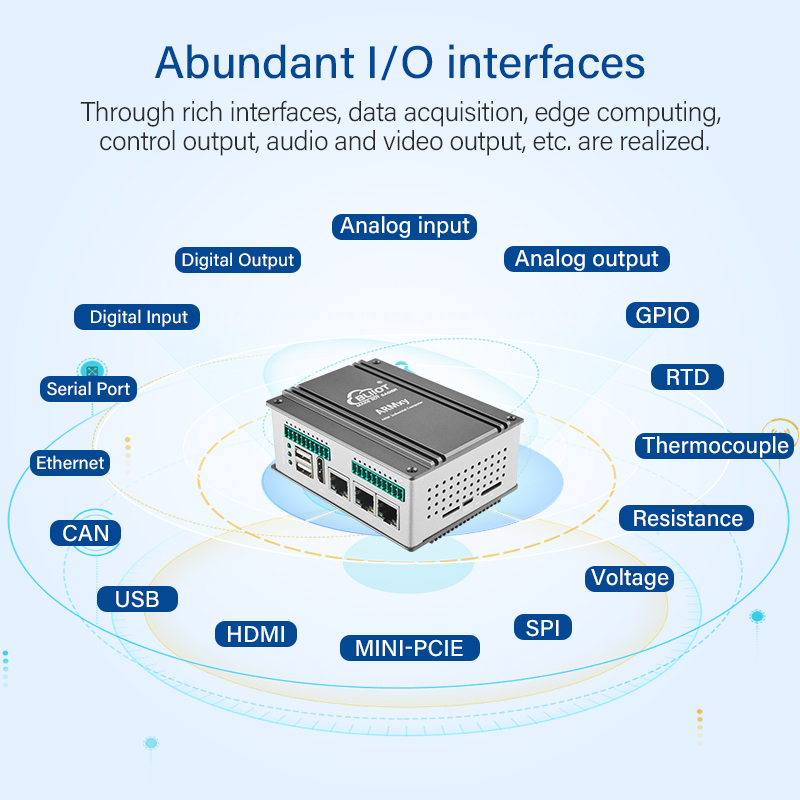
To enable efficient data acquisition and protocol conversion, BESS systems often incorporate ARM-based edge gateways as bridges between the BMS and upper-layer systems. The ARMxy BL410 edge gateway is a high-reliability device specifically designed for such industrial applications.
- Supports X/Y series I/O expansion boards for flexible configuration of RS485, CAN, RS232, DI/DO, AI/AO interfaces.
- Acquires data from battery packs, current sensors, and PCS control units via CAN ports.
- Features a Rockchip RK3568 quad-core Cortex-A55 processor and 1 TOPS NPU for on-device AI algorithms.
- Pre-installed with BLIoTLink protocol conversion software, supporting Modbus, IEC104, MQTT, OPC UA, and more.
- Enables rapid cloud uploading and visualization of BESS data using Node-RED and Docker.
- Complies with industrial-grade -40°C to 85°C temperature range and EMC standards, suitable for power and energy storage sites.
Thus, the BL410 gateway collects BMS data via CAN bus, performs local AI analysis, and uploads it to the EMS or cloud, enabling true edge-intelligent BESS management.
Industry Standards and Practical Applications
In standards from the State Grid Corporation of China and China Southern Power Grid, CAN bus is mandated as a required communication interface between BMS and PCS. Leading BESS manufacturers (e.g., Huawei, Sungrow, BYD, CATL, Pylontech) all provide CAN-based interface protocols.
The ARMxy BL410, with its versatile CAN and RS485 acquisition capabilities, is widely deployed in battery monitoring, BMS communication relaying, PCS control, and data cloud integration.
Conclusion
The adoption of CAN bus communication in BESS is not merely a technical choice but an industry consensus. With its high reliability, strong anti-interference capabilities, excellent real-time performance, multi-node support, and standardized interfaces, CAN bus provides a secure, stable, and efficient communication foundation for BESS.
When paired with CAN-compatible edge gateways like the ARMxy BL410, BESS systems achieve intelligent edge-side data collection, AI analysis, and remote connectivity, driving the digital and intelligent transformation of energy management.