ARM Edge Computing enables enterprises and communities to build truly intelligent, secure, and autonomous security ecosystems through the synergy of facial recognition, video stream analytics, and local alerts.
Case Details
In the realm of smart security, real-time processing, privacy protection, and system reliability are paramount. Traditional cloud-based recognition solutions, while powerful, suffer from network latency, bandwidth consumption, and data security vulnerabilities. Today, ARM-based edge computers are emerging as the new cornerstone of security surveillance. With their high energy efficiency, flexible scalability, and integrated AI computing power, they deliver robust support for on-site real-time analysis.
The Rise of Edge AI in Security
The lightweight evolution of AI algorithms and the widespread adoption of NPUs (Neural Processing Units) have enabled more security scenarios to perform video analysis locally. Examples include:
- Facial recognition for access control at residential community entrances;
- Personnel behavior detection in factory interiors;
- Intrusion alerts for warehouse perimeters at night;
- Visitor logging and identity verification in schools or office buildings.
These tasks demand 24/7 stable operation, real-time detection, and rapid alerting. ARM edge computers are ideally suited to meet these requirements.
System Architecture Overview
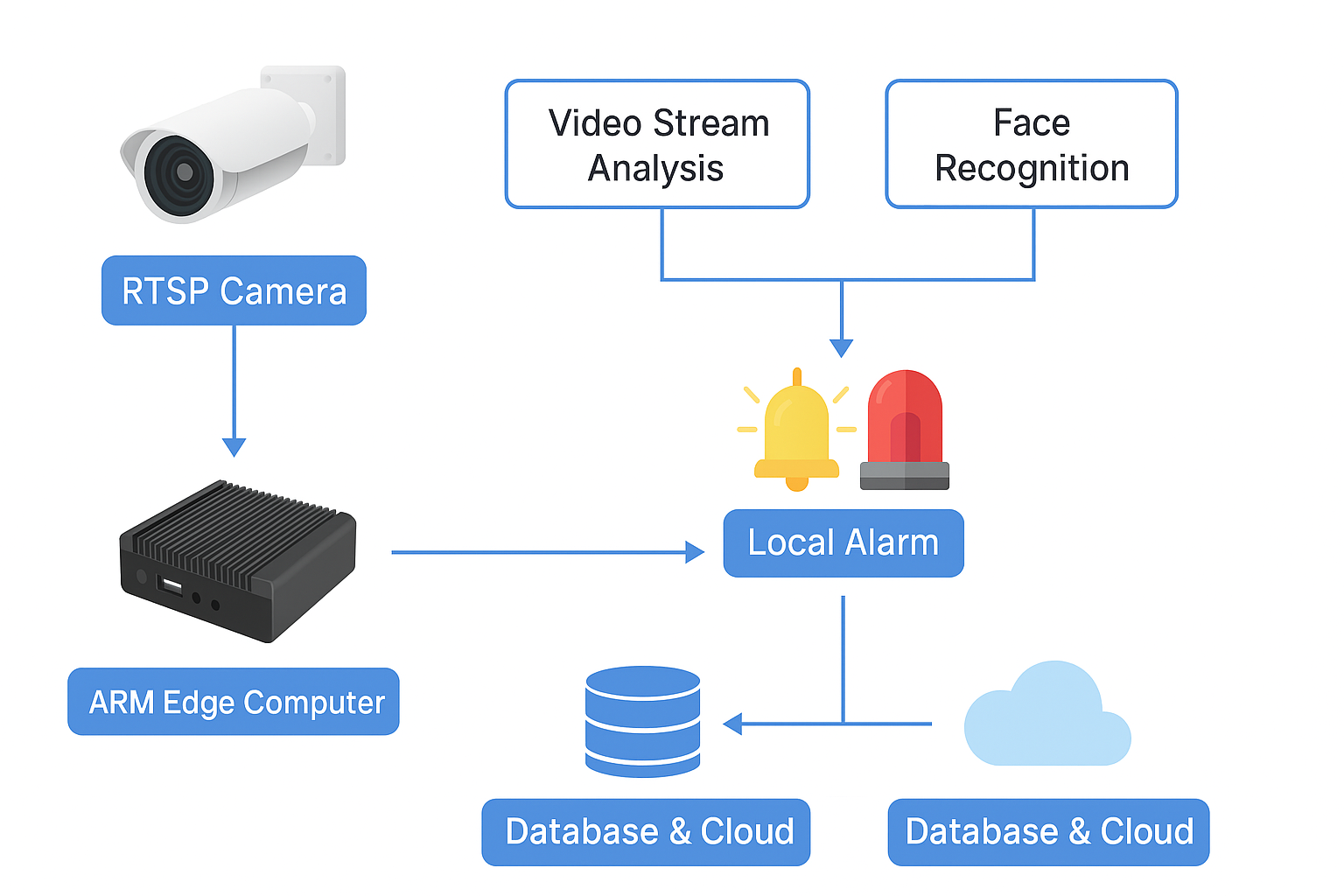
ARM edge computers serve as the "frontline brain" for video analysis, directly interfacing with cameras and alert devices. A typical system architecture includes:
- Video Acquisition: Cameras stream footage to the ARM computer via RTSP/ONVIF protocols;
- AI Inference: On-device NPUs execute facial detection, feature extraction, and identity matching algorithms;
- Video Analysis: YOLO-series algorithms are integrated for behavior recognition or anomaly detection;
- Alert Triggering: Upon detecting unauthorized individuals or abnormal behaviors, local alerts are activated via GPIO, buzzers, strobe lights, or MQTT protocols;
- Data Reporting: Only event summaries and key images are uploaded to the cloud, minimizing bandwidth usage and enhancing privacy.
This architecture forms a closed-loop "front-end detection, edge processing, and local alerting" workflow, ensuring independent operation even during network outages.
Core Technologies and Solution Highlights
ARM + NPU High-Efficiency Computing
Modern ARM platforms (e.g., RK3588, RK3576) incorporate potent NPU modules, delivering 6–20 TOPS of AI inference performance. Paired with optimized lightweight models (e.g., YOLOv8-Tiny, Ultra-LightFace, MobileNet-ArcFace), they enable real-time recognition on 1080p video streams.
Multi-Task Parallel Processing
The system employs multi-threaded pipelines for asynchronous decoding, detection, recognition, and alerting, maintaining low-latency responses even with multiple camera feeds.
Localized Alert Mechanisms
An embedded rules engine drives direct hardware responses based on detection results, including:
- Relay outputs;
- Buzzer or flashing light warnings;
- Access control or lighting devices;
- MQTT/HTTP pushes to central management systems.
This network-independent design ensures instantaneous responses in emergencies.
Data Security and Privacy Protection
ARM edge computers feature encrypted facial databases and access controls, uploading only event abstracts and thumbnails to prevent privacy breaches. The system also supports logging and local auditing to comply with data security regulations.
Application Scenarios
- Smart Parks and Communities: Identify residents vs. strangers at entrances, enabling automatic door access or alerts;
- Factory Production Lines: Monitor personnel entry into hazardous zones;
- Warehousing and Logistics: Deter nighttime unauthorized intrusions;
- Campus Security: Manage student and visitor identification to restrict access to teaching areas;
- Office Buildings: Facilitate intelligent attendance and identity verification.
In these contexts, ARM edge computers integrate seamlessly with existing surveillance systems, upgrading them to intelligent video analytics.
For instance, the BL460 edge controller, based on the Raspberry Pi CM5 and augmented with an M.2 NPU module, scales to 26 TOPS of computing power. It handles multiple high-definition video streams for:
- Real-time facial detection and identification;
- Anomaly behavior analysis;
- Local audio-visual alerts and cloud event reporting.
Its low-power design and industrial-grade reliability make it ideal for unattended deployments, such as building server rooms, road checkpoints, or remote sites.
Conclusion
ARM edge computers are reshaping security surveillance architectures. They not only accelerate recognition speeds and response efficiency but also yield substantial gains in privacy safeguards, system autonomy, and operational costs. Through the synergy of facial recognition, video stream analysis, and local alerts, enterprises and communities can achieve truly intelligent, secure, and self-reliant security ecosystems.
Looking ahead, as AI chips and models continue to advance, ARM edge platforms will play a pivotal role in broader security domains, serving as a foundational pillar for smart city development.


