ARM AI vision controller combines algorithmic flexibility with convenient hardware deployment, providing the manufacturing industry with smarter, more efficient, and more economical workpiece positioning and measurement solutions.
Case Details
In today's increasingly intelligent industrial automation landscape, workpiece positioning and dimensional measurement no longer rely on traditional manual methods or expensive vision systems. Leveraging ARM-based AI vision controllers combined with industrial cameras and OpenCV geometric analysis algorithms, enterprises can achieve efficient, low-latency visual inspection and size determination at the edge. This approach significantly enhances production efficiency and quality control.
System Architecture and Core Components
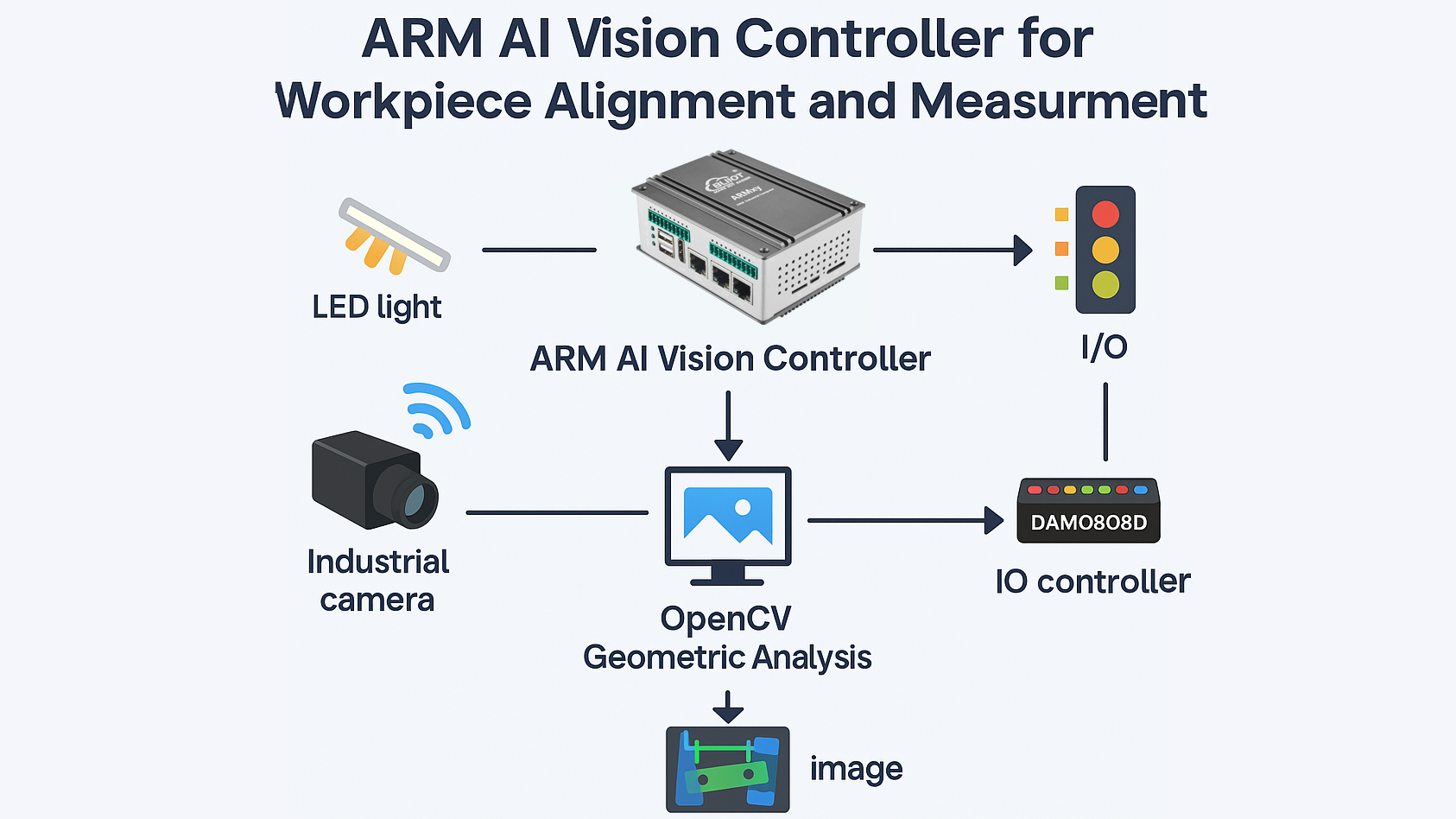
This solution is built on a lightweight, low-power ARM edge computing platform, integrating the following core modules:
- ARM AI Vision Controller: Such as the BL410 series, featuring multiple IO ports, serial interfaces, Ethernet, and other industrial interfaces, with support for Python/C++ algorithm deployment.
- Industrial Camera System: Paired with high-resolution lenses and LED lighting to ensure image clarity and stability.
- OpenCV Vision Algorithms: For image preprocessing, edge detection, contour extraction, and geometric computation.
- PLC Integration Module: Interacts with on-site control systems via IO or Modbus protocols to feedback detection results and control actions.
Workpiece Positioning and Measurement Workflow
The entire inspection process is divided into five key steps:
- Image Acquisition: The camera captures the workpiece image, which the controller receives and buffers.
- Region Identification and ROI Setting: Lock the measurement area using template matching or coordinate designation.
- Image Processing: Includes grayscale conversion, noise filtering, edge detection (e.g., Canny algorithm), and contour extraction.
- Geometric Analysis: Employ OpenCV functions such as cv2.contourArea, cv2.boundingRect, and cv2.minAreaRect to calculate area, edge length, angle, and position.
- Size Conversion and Judgment: Convert pixel measurements to real-world dimensions using a calibration scale, compare against standards, and output OK/NG signals.
Technical Advantages and Deployment Value
- Edge Computing for Real-Time Response: The ARM platform processes images and makes judgments in milliseconds, ideal for high-speed production lines.
- Low Power and High Integration: Compared to traditional industrial PCs, ARM controllers consume less power and have a compact form factor, facilitating embedded deployment.
- Customizable Algorithms: Supports Python/C++ development, allowing users to tailor geometric analysis logic to specific workpiece shapes.
- Cost-Effective and Easy Maintenance: Low hardware costs, open-source software, and simplified upkeep.
Typical Application Scenarios
- Metal Parts Dimensional Measurement: Inspection of outer diameter, hole size, and thickness for nuts, washers, and stamped components.
- Plastic Parts Positioning and Defect Detection: Identification of misalignment, deformation, or material shortages in injection-molded parts.
- PCB Solder Joint Inspection: Detection of missing, cold, or bridged solder joints.
- Glass Panel Edge Recognition: Pre-cut positioning and size verification.
Deployment Recommendations and Optimization Strategies
- OpenCV Compilation Optimization: Enable NEON and VFP instruction sets to boost processing speed.
- Image Acquisition Synchronization: Use hardware triggering to ensure alignment between images and workpiece positions.
- Dimensional Calibration Process: Establish pixel-to-millimeter conversion using standard rulers or calibration plates for precise measurements.
The ARM AI vision controller is emerging as a key player in industrial visual inspection. Its blend of algorithmic flexibility and hardware deployment ease provides manufacturing with smarter, more efficient, and cost-effective solutions for workpiece positioning and measurement.


