The T113-i SoM330 core board integrates computing, communication, display, and control functions, providing strong support for solar and energy storage controllers and accelerating the intelligent upgrade of energy systems.
Case Details
Under the "dual carbon" strategy, solar and energy storage systems have emerged as key pillars of the energy transition. Achieving efficient, stable, and intelligent control and management remains a critical challenge for the industry. BLIIOT's T113-i SoM330 series core board, with its powerful heterogeneous computing architecture, abundant interface resources, and industrial-grade stability, serves as the ideal platform for intelligent energy controllers.
Heterogeneous Multi-Core Architecture: Driving Intelligent Control
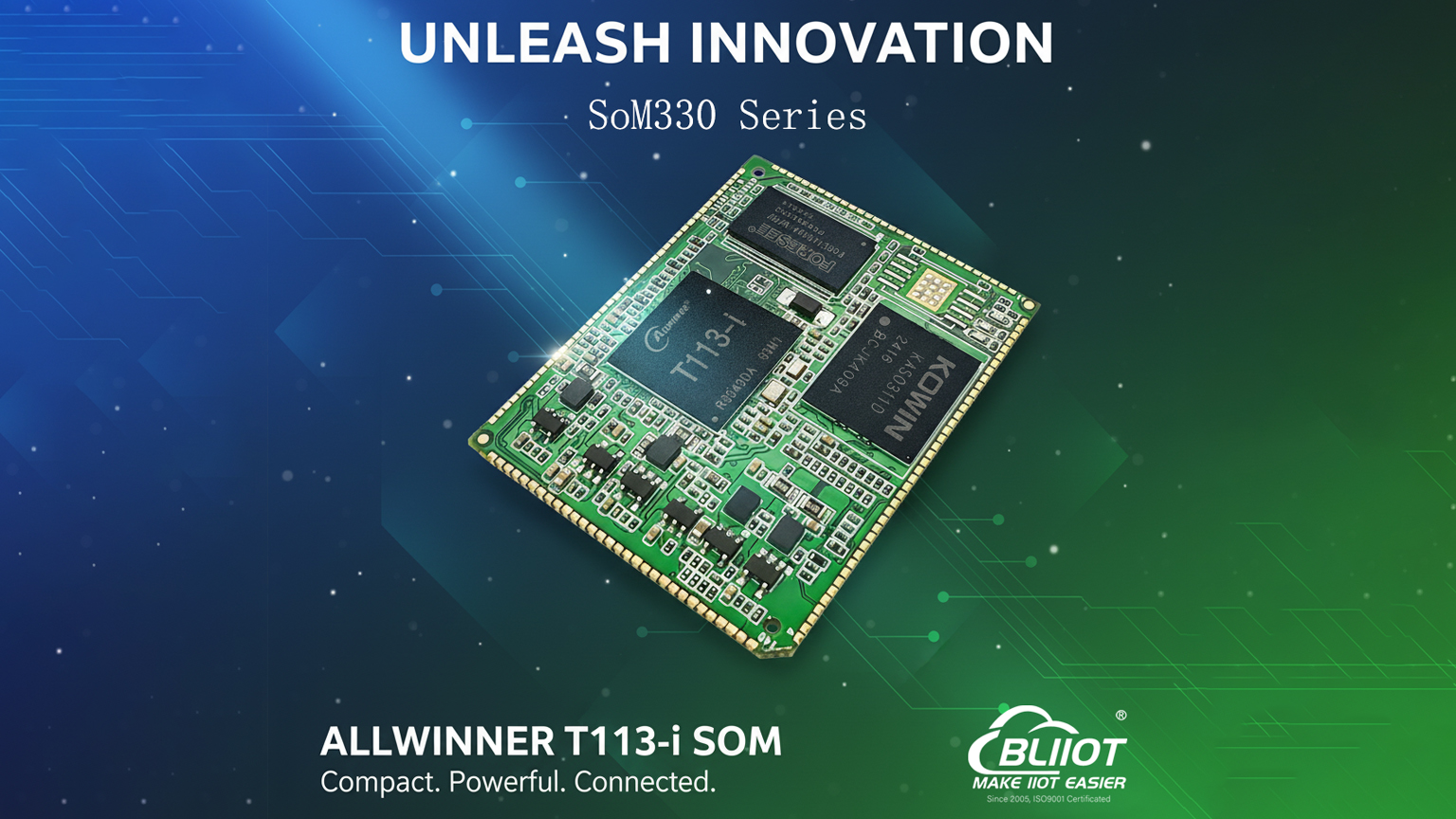
The T113-i SoM330 core board is powered by the Allwinner T113-i processor, integrating three core architectures: dual-core ARM Cortex-A7, Xuantie C906 RISC-V, and HiFi4 DSP. This enables task separation and parallel processing. The ARM cores handle primary control logic and communication protocols, the RISC-V adapts to custom algorithms and edge computing, and the DSP focuses on audio processing and signal filtering. This architecture delivers efficient, low-latency computing for controllers like EMS (Energy Management Systems) and BMS (Battery Management Systems).
Abundant Interface Resources: Connecting the Full Energy System Chain
With up to 140 pins, the SoM330 core board supports a wide range of industrial interfaces, including CAN, UART, SPI, TWI, ADC, and PWM, allowing seamless integration with peripherals such as battery packs, current/voltage sensors, inverters, and touch screens. Dual CAN buses comply with CAN 2.0A/B protocols to meet mainstream energy storage BMS communication needs. Multi-channel ADC and TPADC enable synchronized acquisition for high-precision electrical parameter monitoring. The EMAC Gigabit Ethernet port and USB interfaces facilitate remote data uploads and firmware upgrades.
Graphical Display and Human-Machine Interaction: Enhancing Operations and Maintenance
The SoM330 supports multiple display interfaces like LVDS, RGB, and MIPI DSI, with up to 1080P@60fps output resolution, compatible with industrial touch screens and HMI interfaces. Paired with Qt graphics development tools and Linux systems, it enables rapid creation of local O&M interfaces for visualizing device status, configuring parameters, and diagnosing faults.
Comprehensive Software Ecosystem: Accelerating Development and Deployment
The core board supports mainstream operating systems such as Linux, Linux RT, Ubuntu, and OpenWrt, along with full SDK and driver support for modules like CAN, Ethernet, USB, ADC, LCD, and Touch. Official resources include Docker containers, MQTT protocols, EtherCAT master stations, and development examples for LoRa/4G/NB-IoT, significantly shortening development cycles and lowering integration barriers.
Industrial-Grade Reliability: Ensuring Stable Outdoor Operation
Validated through high-temperature testing and professional electrical design, the SoM330 operates reliably in -40°C to 85°C industrial temperature ranges, ideal for harsh environments like outdoor PV stations, energy storage cabinets, and charging piles. Typical power consumption ranges from 0.6W (idle) to 1.11W (full load), supporting low-power system designs.
Expanded Application Scenarios
- PV Inverter Master Control: Implements MPPT algorithms, status monitoring, and remote communication.
- Energy Storage BMS Master Control: Collects battery data and executes safety strategies.
- EMS Energy Management System: Builds local control and cloud-based scheduling platforms.
- Outdoor Energy Storage Cabinet HMI: Provides graphical interfaces and touch interactions.
- Charging Pile Controller: Supports card swiping, display, and backend data uploads.
The T113-i SoM330 core board is more than a high-performance embedded platform—it's the "neural hub" of intelligent energy systems. By integrating computing, communication, display, and control, it provides robust support for solar and energy storage controllers, accelerating the intelligent upgrade of energy systems.


