RK3588 AI Edge as Reshape IoT Hub architecture not only optimizes resource utilization and real-time performance, but also provides enterprises with a safer and more flexible IoT deployment model.
Case Details
With the explosive growth of Internet of Things (IoT) devices, traditional "cloud-centric" architectures face multiple challenges, including bandwidth, latency, security, and cost. Previously, all sensor and terminal data had to be sent to the cloud for centralized processing, which strained network and storage resources and struggled to meet demands for real-time control and privacy compliance. Against this backdrop, AI edge computers based on the Rockchip RK3588 are emerging as the core of next-generation IoT Hub architectures, driving the adoption and proliferation of "edge computing + cloud collaboration."
-
High-Performance Heterogeneous Architecture: The RK3588 integrates a 4×Cortex-A76 + 4×Cortex-A55 multi-core CPU with a clock speed of up to 2.4GHz, balancing performance and energy efficiency.
-
AI Acceleration Capabilities: Equipped with a powerful NPU, it enables local execution of AI inference tasks such as speech recognition, video analysis, and anomaly detection, achieving millisecond-level responses.
-
Multimedia and Interface Support: Supports 8K video encoding/decoding, multi-channel camera inputs, and a wide range of industrial interfaces (RS485, Ethernet, PCIe, GPIO), enabling seamless integration with sensors, PLCs, and cameras.
-
Edge Deployment Friendly: Low-power design and versatile storage/expansion configurations make it suitable for diverse edge scenarios, including smart factories, intelligent buildings, and transportation/energy systems.
Transformation of IoT Hub Architecture
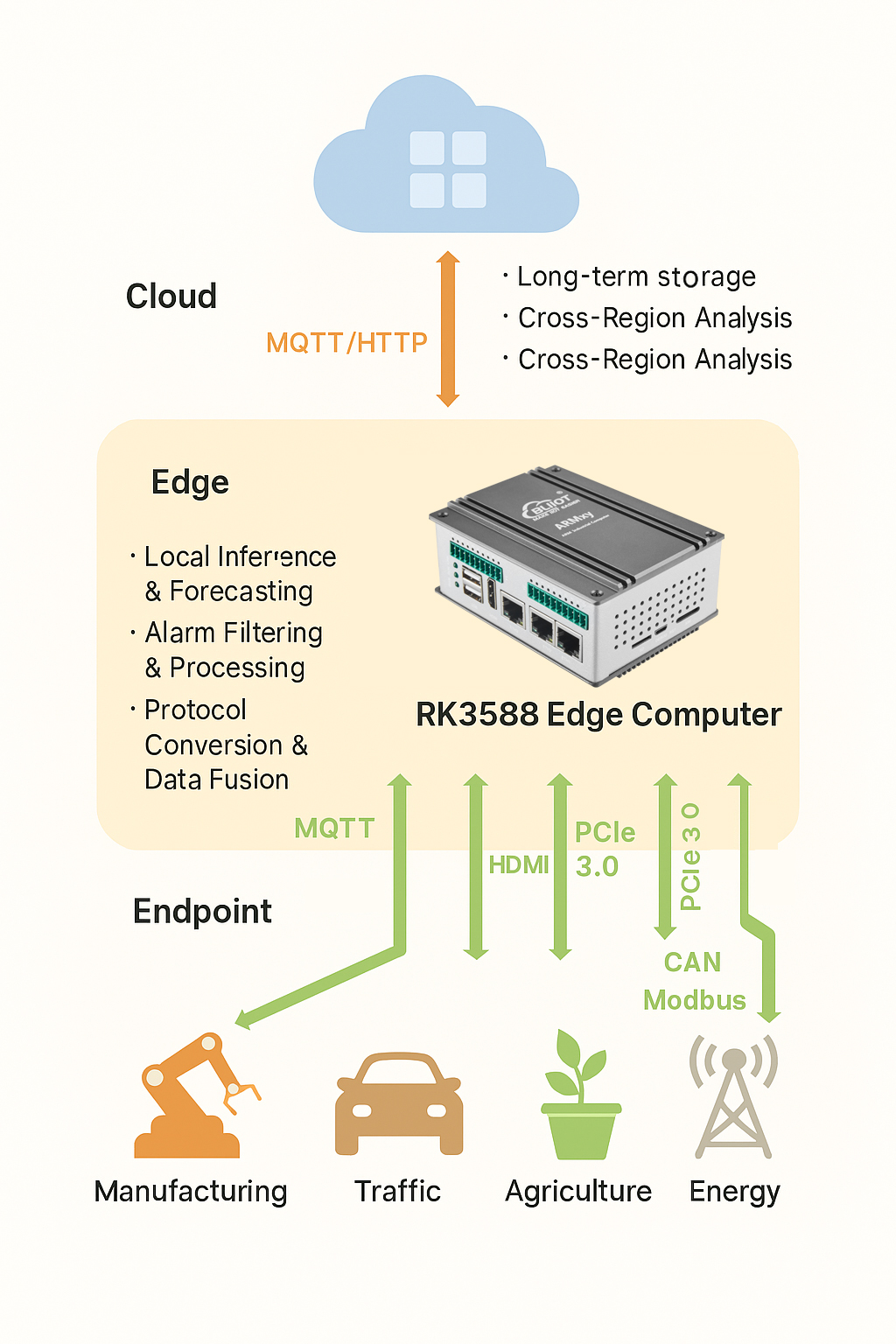
Traditional IoT Hub architectures were cloud-centric, with edge devices primarily responsible for data collection and transmission. Empowered by the RK3588, IoT Hubs are shifting to an "edge-first" model:
-
Edge Intelligence Filtering: The NPU enables real-time analysis of video streams, audio, or vibration data at the edge, uploading only critical events or feature data, reducing network bandwidth usage by over 70%.
-
Low-Latency Closed-Loop Control: Devices can respond directly at the edge without waiting for cloud computation results. For example, in cases of abnormal vibrations in industrial equipment, local systems can trigger immediate shutdown protection.
-
Hierarchical Model Collaboration: The cloud handles training and managing complex models, while lightweight inference models are deployed at the edge, supporting differential updates and rapid rollbacks for seamless cloud-edge evolution.
-
Security and Privacy Protection: Data desensitization and local storage at the edge prevent large-scale transmission of sensitive data to the cloud, meeting various compliance requirements.
Typical Application Scenarios
-
Smart Factories: Multi-channel industrial cameras connect to the RK3588, enabling edge-based defect detection, with only statistical and alert data uploaded to the cloud.
-
Energy Monitoring: Edge nodes analyze sensor data in real-time to predict motor or pump failure trends, minimizing downtime losses.
-
Smart Cities: Edge devices at intersections perform video recognition for traffic flow statistics, illegal parking detection, and pedestrian safety alerts.
-
Building Management: Edge gateways monitor lighting, temperature control, and security systems, enabling energy savings and local automated control.
Value of Edge-Cloud Collaboration
-
Bandwidth and Cloud Cost Savings: Significantly reduces unnecessary data uploads, lowering operational costs.
-
Enhanced System Reliability: Edge nodes maintain critical operations during unstable network conditions.
-
Faster Business Iteration: OTA updates and edge container deployments enable rapid iteration of AI models and application logic.
-
Strengthened Security: Local data processing reduces the risk of data leaks, while secure boot and encrypted communication establish a trusted link.
Conclusion
The emergence of RK3588 AI edge computers transforms IoT Hubs from mere "cloud data relay stations" into "edge intelligence centers." This new architecture optimizes resource utilization and real-time performance while providing enterprises with a more secure and flexible IoT deployment model. In the future, as edge AI computing power becomes more widespread, IoT Hubs will shift from centralized to distributed collaboration, truly realizing a new paradigm of "edge as a service, empowered by the cloud."


