ARM Edge gateways integrate sensor data and automatically adjust based on environmental changes, providing efficient and intelligent building management solutions.
Case Details
With advancements in smart building technology, building management systems are rapidly evolving toward automation and intelligence. The ARM edge gateway, a critical component of building management, integrates multiple sensors and intelligent algorithms to enable automated regulation of lighting and temperature control systems. This article explores the application scenarios and key functions of ARM edge gateways in smart lighting and temperature control.
Background of Smart Building Needs
In modern building management, lighting and air conditioning systems account for a significant portion of energy consumption, contributing heavily to operational costs. Due to the dynamic nature of building environments, energy waste is common, such as lights and air conditioners running in unoccupied rooms. Therefore, automatically adjusting lighting and temperature control based on real-time needs is key to improving energy efficiency and occupant comfort.
As a core control unit in smart buildings, the ARM edge gateway efficiently manages lighting and temperature control systems by collecting, processing, and analyzing real-time environmental data. It connects to various sensors, such as PIR (passive infrared) sensors, light sensors, and temperature/humidity sensors, transmitting data to a central control system or cloud platform to execute predefined control strategies.
Automated Control of Smart Lighting Systems
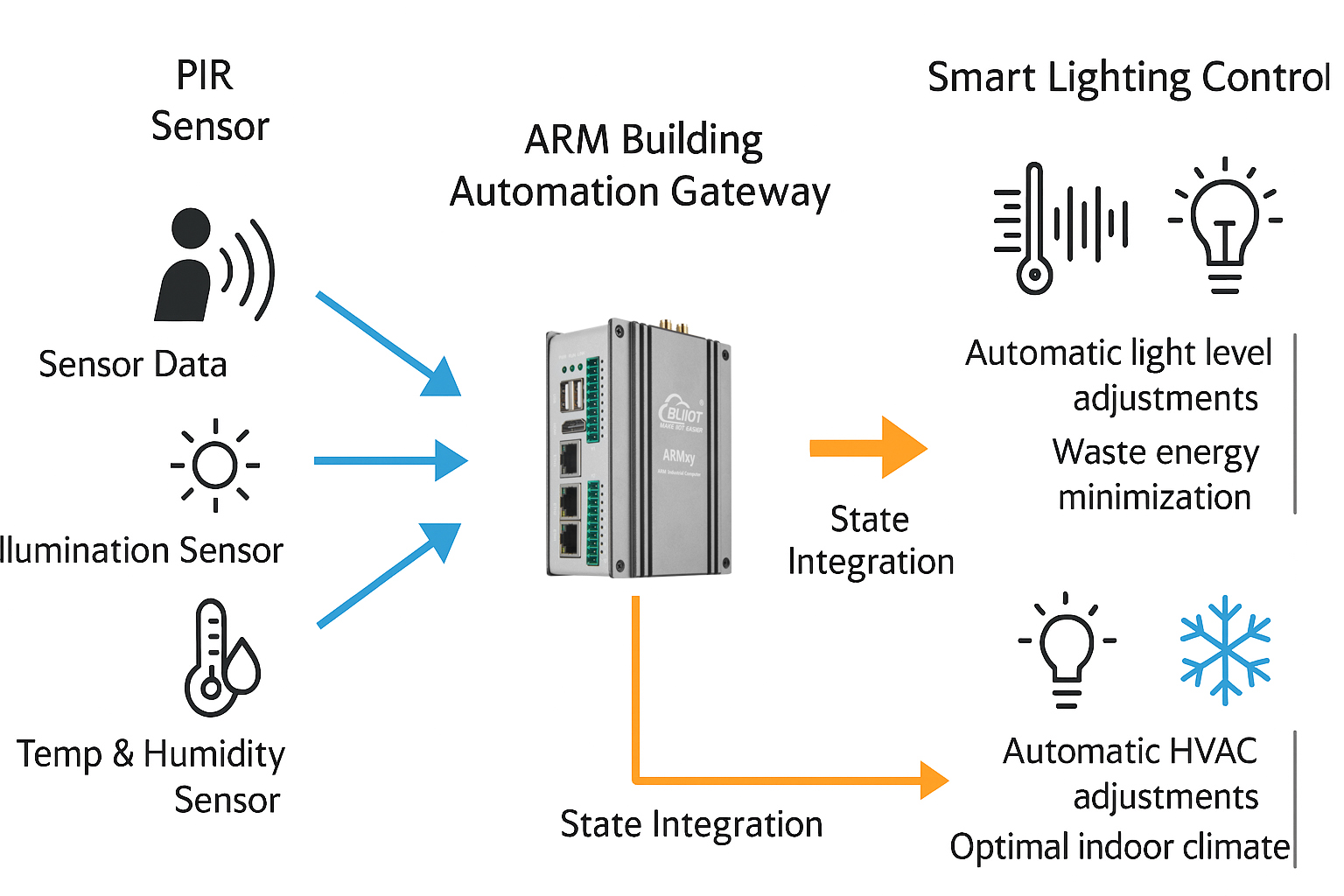
Smart lighting is a key application of ARM edge gateways. PIR sensors detect human activity in real time, enabling the system to automatically turn lights on when someone enters a room and off when the room is empty. This occupancy-based lighting control reduces energy waste and extends the lifespan of lighting fixtures.
Additionally, light sensors adjust indoor lighting intensity based on natural light levels. For instance, on bright sunny days, the system dims indoor lights to save energy while maintaining comfortable lighting conditions.
Dynamic Regulation of Smart Temperature Control Systems
The ARM edge gateway, integrated with temperature and humidity sensors, monitors indoor environmental changes in real time and adjusts air conditioning systems to maintain comfortable conditions. During low-demand periods (e.g., when rooms are unoccupied), the system reduces or shuts off air conditioning power to save energy. During high-demand periods, such as when multiple people enter a meeting room, it dynamically increases cooling output to ensure comfort.
Multi-Sensor Data Integration and Automation
The ARM edge gateway excels at integrating data from multiple sensors, including PIR, light, temperature/humidity, air quality, and CO2 sensors, to comprehensively monitor indoor environments. Based on predefined algorithms, the gateway automatically adjusts systems, such as activating ventilation when CO2 levels are too high, ensuring fresh air quality.
Remote Monitoring and Management
Connected to cloud platforms, the ARM edge gateway enables remote monitoring and management. Building managers can use smartphones or computers to check the real-time status of lighting and temperature control systems, perform remote adjustments, and diagnose issues, enhancing management efficiency and reducing manual intervention.
System Advantages and Conclusion
By deploying ARM edge gateways to control smart lighting and temperature systems, building managers can significantly improve energy efficiency, reduce waste, and enhance occupant comfort. The gateway’s integration of sensor data and automated regulation based on environmental changes provides a highly efficient and intelligent building management solution.
Key Advantages:
- Energy Efficiency: Automated lighting and temperature control reduces energy waste and operational costs.
- Enhanced Comfort: Intelligent regulation of temperature, humidity, and lighting ensures a comfortable indoor environment.
- System Integration: Multi-sensor data integration enables precise responses to environmental changes, elevating the intelligence of building management.
As technology advances, ARM edge gateways will play an increasingly vital role in smart building management, offering energy-efficient, intelligent, and effective solutions for modern buildings.


